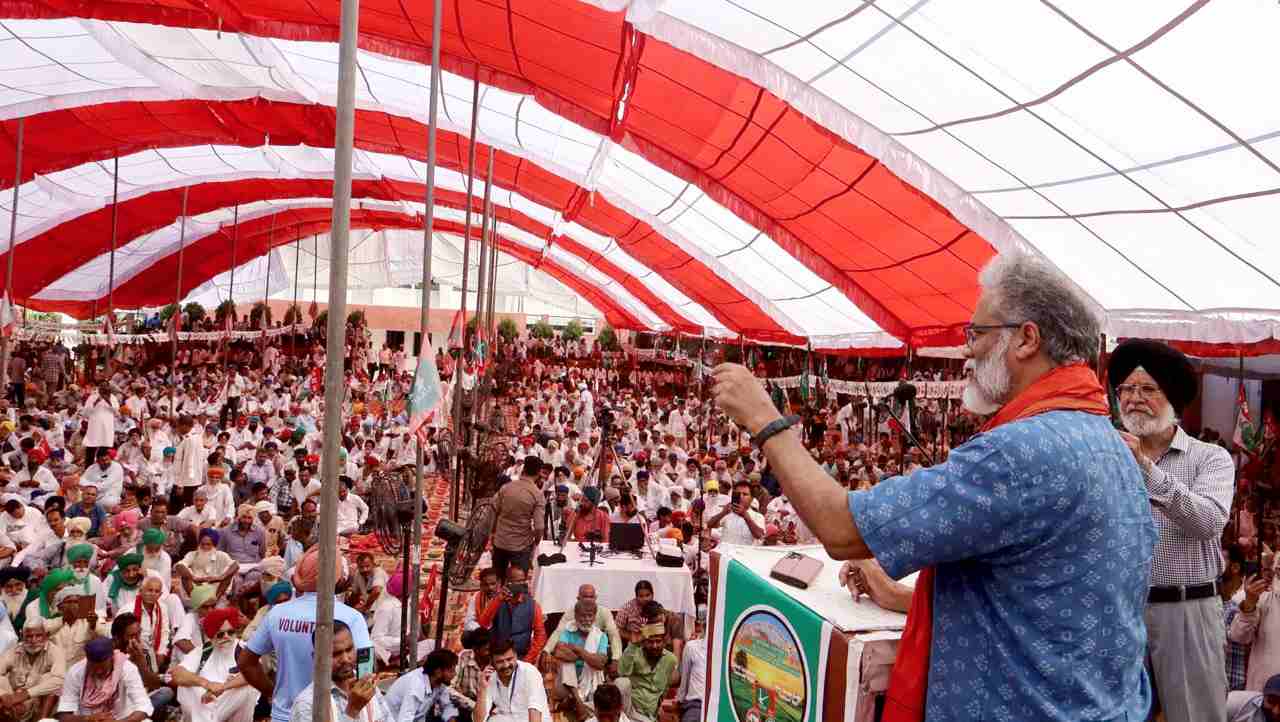
On 20 September, more than 10,000 farmers and workers from every corner of Punjab participated in a Farmers–Workers Unity Rally held at the Shaheed Bhagat Singh Auditorium at Desh Bhagat Yadgar, Jalandhar. The response of the farmers and workers overwhelmingly exceeded the expectations of the organisers, and the rally had to be live streamed in the adjoining park and in an adjoining hall. Despite these arrangements, thousands of people stood outside the Desh Bhagat Yadgar Complex, on the road, to lend their voice to the movement.
The conference also marked the merging of two prominent farmers organisations of Punjab that were key constituents of the farmer struggle at the Delhi borders in 2021, Jamhoori Kisan Sabha Punjab (JKSP) and Punjab Kisan Union (PKU), into the All India Kisan Mahasabha.
The inaugural flag was unfurled by Ruldu Singh Mansa, National President of the Kisan Mahasabha. The central slogan of the rally was: “Save Fields, Agriculture and Freedom - End Corporate Loot.”
The rally was addressed by leaders of the CPI(ML) Liberation, AIKM, the JKSP, the All India Agricultural and Rural Labour Association, the Mazdoor Mukti Morcha Punjab; and the Dihati Majdoor Sabha.
Addressing the rally, Comrade Raja Ram Singh, Member of Parliament and outgoing General Secretary of the AIKM, said that through attempts to establish control over Venezuela and attacks on Gaza and Iran, American imperialism was seeking to gain control over natural resources and fertile land across the world. He said that although the Modi government has bowed before the Trump administration through a free-trade agreement, farmers and workers in the country would firmly oppose such efforts.
While farmers were fighting for C2+50% Minimum Support Price (MSP) for their crops, they were also fighting against the large-scale acquisition of fertile agricultural land, which posed a threat to the country’s food security. By opposing air and water pollution, and the environmental destruction caused by corporate industries, farmers were not fighting merely for themselves but for the interests of the wider population.
Comrade Dipankar Bhattacharya, General Secretary of CPI(ML) Liberation, highlighted the historical importance of the JKP and PKU becoming part of the AIKM, a development which would give new momentum to the farmers’ struggle and popular movements against the “corporate-backed communal-fascist Modi government”.
Comrade Mangat Ram Pasla, General Secretary of the Revolutionary Marxist Party of India, said that the waves of unity among farmers’ organisations that had begun in Punjab would spread across the country and inspire farmers’ and workers’ organisations to unite. He said that a broad unity of the country’s revolutionary, democratic and patriotic forces was essential to counter the anti-worker, anti-farmer, anti-Dalit, anti-minority, anti-democratic and anti-federal ideology of the RSS-BJP and to remove them from power.
He said that the need of the hour was for the people of Punjab to decisively reject BJP’s false claims and elect genuine representatives committed to uncompromising struggles for farmers, workers and youth in the forthcoming elections.
The two-day conference was attended by 870 delegates and observers coming from 20 states. The report tabled by the outgoing General Secretary was passed unanimously after thorough discussions, incorporating various suggestions from the house. The Conference elected 148 members council which further elected 59 members Executive committee in its brief meeting. Dr. Satnam Singh Ajnala was elected All India President and Purushotam Sharma was elected General Secretary.
The conference passed various resolutions including a call to support the victims of the recent floods in Nepal; a demand that India not sign the anti-farmer one-sided India-US trade agreement; minimum support price to all farmers and on all crops at C2+50% formula; loan waiver for farmers and agricultural workers; stopping of forcible acquisitions of agricultural land; withdrawal of the pro-corporate Seed Bill draft, draft Electricity Bill, and the draft Agricultural Trade and Marketing Policy.
The unity demonstrated by farmers’ organisations in Jalandhar is fresh impetus to the farmers’ movement across the country.
===

Let AIKM March Ahead with Greater Unity and Stronger Resolve
(abridged version of Comrade Dipankar's address at the 5th Conference of AIKM in Jalandhar)
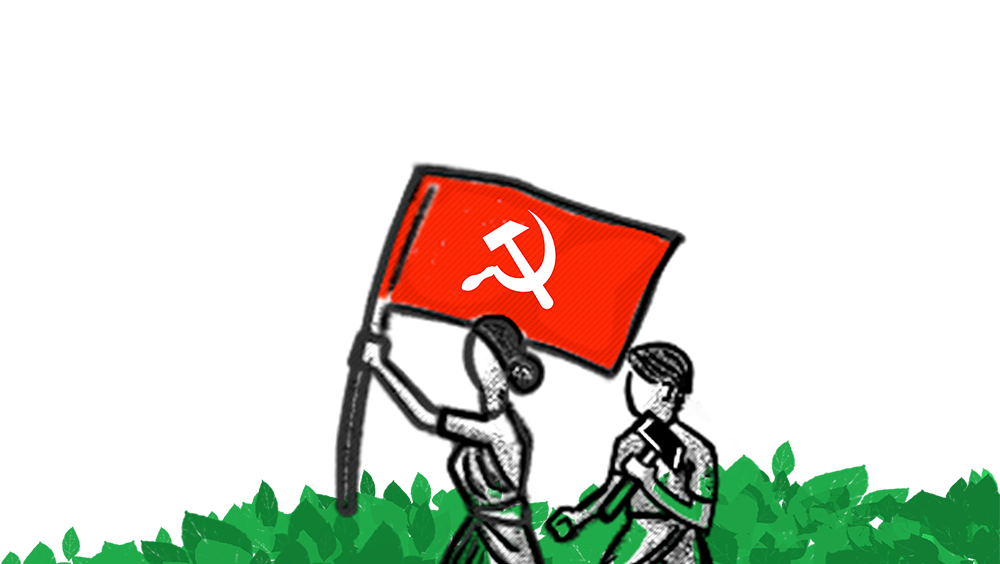
The highlight of the 5th conference of All India Kisan Mahasabha is the coming together of Punjab Kisan Union, already affiliated to AIKM, and two leading farmer organisations of Punjab and Haryana, Jamhoori Kisan Sabha and Pagdi Sambhal Jatta, under the AIKM banner. This unification of three organisations that played a key role in the historic Delhi border farmers' movement into one single organisation, adopting a new red and green flag, is a very encouraging development at a time when the farmers' movement faces an intensified imperialist threat in addition to the relentless danger of corporate takeover of agriculture.
All these three organisations have emerged from the communist tradition and hence this unification also has great significance for the communist movement and the communist agenda of agrarian revolution as the answer to India's deepening agrarian crisis. It will therefore be in order at this moment to reiterate certain fundamentals about the communist orientation in the peasant movement.
Peasants by nature are patient and know how to wait for the crops to grow. Given the all pervasive infrastructural crisis of agriculture, farmers are familiar with frequent crop failures and have the tenacity and resilience to cope with a chronic crisis. Communists do not mistake this patience and tenacity of the peasants as signs of conservatism, communists do not see farmers as a citadel of social reaction, on the contrary they recognise the peasantry as a fighting force, engaged in a protracted struggle not just for survival but for social transformation. This is why the communist movement which began as a revolutionary movement of the working class soon discovered the great revolutionary potential of the peasantry and came up with the historic vision of worker-peasant alliance as the crucial foundation of socialism.
Communists also do not consider farmers as a homogeneous community. While all sections of society directly involved in agriculture share several common traits and vulnerabilities, communists never lose sight of the fact that the farming community or agricultural population actually comprises several classes from the rich farmers down to the landless poor labourers and marginal peasants cultivating leased-in land.
From the days of Swami Sahajanand Saraswati, in whose name you have christened Jalandhar for the purpose of this conference, communists have focused, first of all, on the landless poor labourers and marginal farmers, who have historically constituted the most oppressed segments of our society. It was this focus which gave rise to the Naxalbari peasant uprising as the successor of the great Tebhaga movement of Bengal, Punnapra-Vayalar of Kerala, Telangana of erstwhile Andhra Pradesh or Muzhara Lehar of Punjab.
Forty years ago we had produced an authoritative account of the revolutionary peasant movement in Bihar called the Report from the Flaming Fields of Bihar. In the introduction to that book, Comrade Vinod Mishra had referred to the contention between the East and West winds in India's agrarian struggles. He adapted the East versus West wind metaphor used by Mao during the Great Debate in the international communist movement where the East wind referred to the advance of socialism and the West wind symbolised western capitalism. In the Indian context Comrade VM used the West Wind metaphor for the emerging movement of rich farmers started by Sharad Joshi from Maharashtra against the backdrop of the crisis of green revolution while the East Wind referred to the communist-led revolutionary peasant movement of Bihar.
The two winds met in the historic Delhi border movement and forced the government to repeal the pro-corporate farm laws. The underlying contention between the two winds clearly did not preclude their cooperation in the larger anti-corporate anti-imperialist context. The east-west contention is not a geographically delineated contention between the eastern and western regions of India, it permeates the whole of India. Within Maharashtra and Punjab, the communist-led farmers' movement has stood firm in championing the interests of the small and marginal farmers, and in Bihar the AIKM started its journey on May 10, 2010, on the 153rd anniversary of great 1857 War of Independence, even as feudal forces threatened a bloodbath following the submission of the Land Reform Commission report.
The journey of the revolutionary peasant movement enters a new phase today with greater strength and renewed resolve to defend India's agricultural population against corporate and imperialist aggression, to strengthen India's ongoing battle for freedom from fascism and to advance the protracted quest for an egalitarian social order. The CPI(ML) wishes every success to the 5th Conference of the All India Kisan Mahasabha in this historic long march.