Over 8 lakh demonstrators have taken to the streets of France in the last month. While the protests started as a focused student movement demanding better infrastructure and funding for education, the heavy-handed response of the national government has diversified the demographics and aims of the movement, and brought the economic crises facing the country into sharp relief.
GDP per capita in France has stagnated to less than 1% annual growth rate since the economic crisis of 2008, and youth unemployment currently stands at a staggering 20%. This has created a cyclical condition where the government cannot generate enough tax revenue, forcing it to borrow: France’s total debt now stands at more than its entire GDP.
As the demonstrators shun conservatives and liberals, they have welcomed the French Left, which finds its voice in Jean-Luc Mélenchon. Mélenchon, leader of the La France Insoumise, has publicly called for “freezing” the national debt owed to the Bank of France and the European Central Bank's Eurosystem, a move that would likely trigger a fissure in the Eurozone.
In some ways, France represents the malaise that spreads through European imperial core: its other major economies like Germany, Spain and Italy have gone through periods of high inflation. Youth unemployment in Spain and Italy also exceeds 20%, and their national debt is also soaring. These crises in Europe are exacerbated by the subservience of its political class to US whims, which promotes militarisation and international adventurism instead of heeding the demands of the working classes. —Ed.
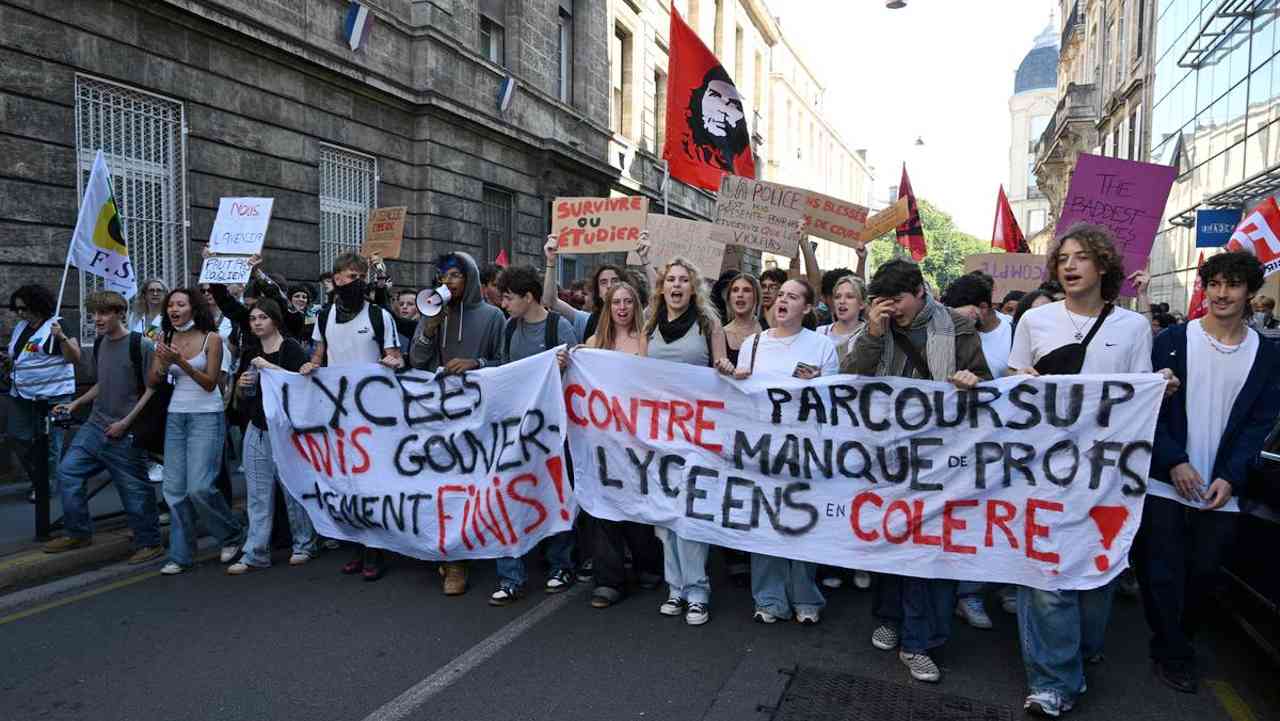
In 2025, as a lecture ended at my university in Paris, I noticed a few students talking with the professor. They needed to leave early, and I heard her say she would try to give them as much time as possible before the other classes finished. It made little sense to me at the time; it seemed an otherwise ordinary day, and I paid it no attention. As I left the building, however, I saw those same students standing outside with a megaphone. They had hung a banner on the front gate and were chanting, “Free, Free Palestine!” Was this why they had left class early? Was this what the professor had been referring to?Demonstrations like this are common at most public universities in France. Students often organise a blocus (blockade), a well-established protest strategy in which they barricade the institution’s entrance with heavy objects, often garbage bins, and halt all academic activity to pressure the administration and the government. French students learn to mobilise and voice their political opinions as early as high school. This has been especially visible in recent weeks, with lycéens (high-schoolers) demonstrating since late September to make their grievances heard.
What began as a strike at the Lycée Saint-Exupéry in Créteil, a Parisian suburb, has since spread nationwide. According to the French newspaper actuParis, the first protests began on September 21st, when students joined a teachers’ strike over low pay and insufficient postings. Drawing on the broader discontent of other public servants, including firefighters and nurses, the students organised a blocus that quickly gained momentum in other suburban schools. According to The Guardian, approximately 400 high schools were blockaded, prompting the national high-school union, Union Syndicale Lycéenne, to call for a nationwide blockade and mobilisation on September 29th.
While the late-September demonstrations served as a starting point, the union followed up on October 1st with what it called “Acte 2” (Act 2), extending the high-school protests to universities with the support of unions, including La Fage, L’Union Étudiante, and L’Unef. Multiple universities across France joined the mobilisation. Public spaces, too, were marked by violence and brutal police repression. Minister of Education Édouard Geffray claimed that violent groups had infiltrated the mobilisation and ordered a shift to online education as high schools closed. As the movement spread across the country, protests turned decidedly violent in several locations, with demonstrators beaten and tear-gassed. In one harrowing incident in Lens, a high-school student was severely injured when a grenade exploded in his hand.
The students’ protests stem from the current government’s policies, which have brought significant budget cuts across major public sectors. According to France 24, the government aims to save 43 billion euros amid spiralling public debt. These austerity measures include freezing wages and pensions and fund cuts for almost all public services. In education alone, the government has eliminated 1,588 teaching posts, cuts that Geffray has defended by pointing to declining student enrolment.
In announcing the nationwide protest, the high-school union cited teaching staff shortages, poor infrastructure, and densely packed timetables that keep students at school for exhausting hours. Students also raised complaints about Parcoursup, the French platform for university admissions introduced by the Macron government in 2018. Earlier, students were admitted to university through APB (Admission Post-Bac), meaning admission based on the Baccalauréat exam. More importantly, universities were not allowed to take in students completely on the basis of merit. Parcoursup transformed this process by prioritising merit and allowing students to be selected based on their academic standing. Students argued that its reliance on continuous assessment and merit ignores the realities of racial and financial hardship, since students from underfunded suburban schools are structurally disadvantaged by algorithmic grading. Crucially, French students have also spoken out against differentiated (higher) tuition fees for non-European students and demanded the abolition of the CVEC, a 100-euro student service fee paid at enrolment alongside tuition, another policy adopted by the Macron government as part of the “Bienvenue en France” (Choose France) program aiming to increase the number of international students in France. Earlier, both European and non-European students paid a subsidised amount (243 euros for Masters and 170 euros for Bachelors).
Yet, while the government repeatedly cites ballooning debt when students demand adequate funding for what is a constitutional right, it simultaneously displays opulence in military and ammunition deals. According to an Al Jazeera article titled “‘Multiple Threats’: Macron Raises France’s Military Budget 40%,” the military budget for 2024–2030 will stand at 413 billion euros, up significantly from the 295 billion euros allocated over the previous six years. Furthermore, an investigation led by the Palestinian Youth Movement and the French collective Urgence Palestine revealed that France continues to supply military equipment to Israel, contrary to government claims made in 2024.
The glaring contradiction between the students’ grievances and France’s budgetary priorities suggests that the government is more interested in funding the research and development of armaments, used to perpetrate violence both against its own citizens as they protest and in Palestinian conflict zones. The students, therefore, are not just complaining about overloaded timetables and a lack of toilet paper. They are demanding accountability from a government that chooses to turn a blind eye to the precarious circumstances of its own people, while emptying its coffers for what can only be complicity in genocidal violence.