
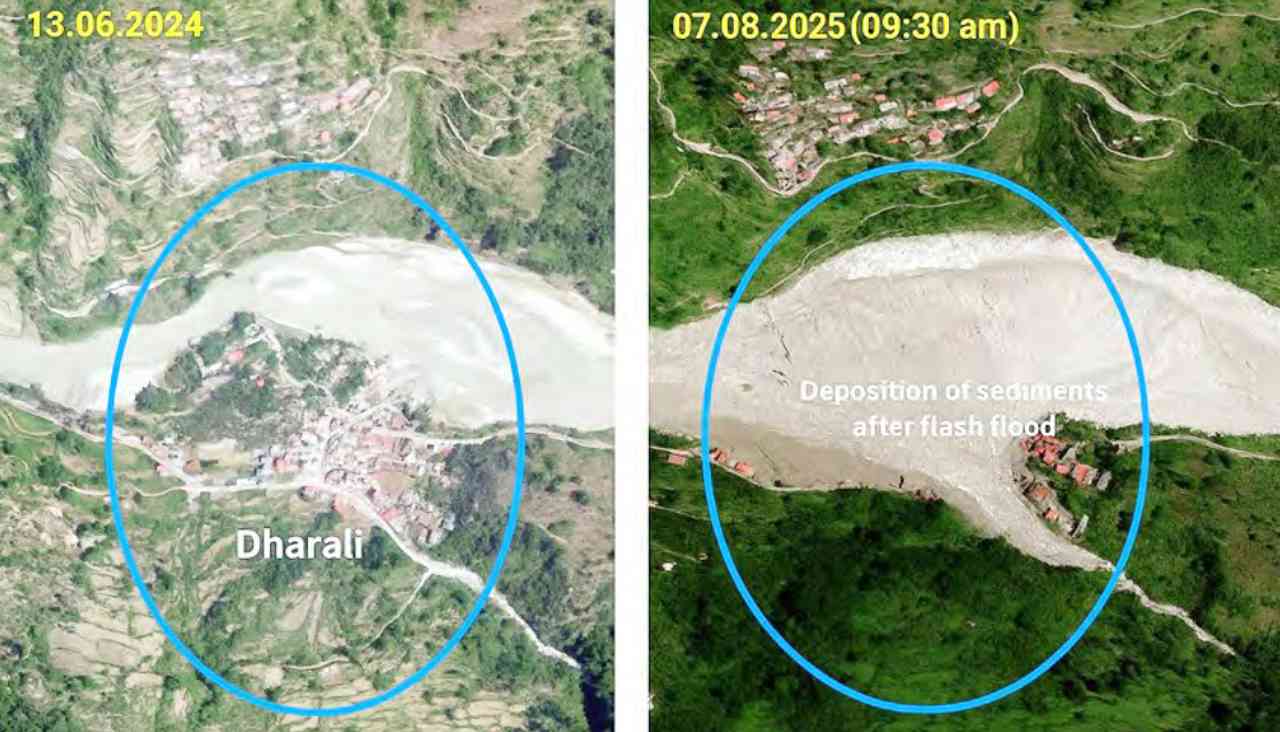
In Uttarakhand, areas including Tharali and other parts of Chamoli district, Sanji, Buransi, and Bankuda in Pauri, Chenagad in Rudraprayag, vast sections of Dehradun, and Ghat (Nandanagar) in the Chamoli mountains were devastated, with roads washed away and homes buried under debris. Himachal Pradesh witnessed similar heart-wrenching destruction, as flash floods and landslides swept through Mandi, Kinnaur, Kullu, Manali, and surrounding areas, destroying roads, bridges and homes. Jammu and Kashmir was battered by relentless cloudbursts and flash floods, causing widespread devastation in Kishtwar, Reasi, Ramban, and nearby districts. The combined impact caused rivers such as the Chenab, Jhelum, Tawi, Beas, and Sutlej to overflow, with flooding felt downstream in Punjab and across the border.
These catastrophes have claimed hundreds of lives, left thousands injured, and caused massive destruction of homes, roads and infrastructure. However, these were not merely national disasters; they are a stark manifestation of the dangerous convergence of climate change, unplanned development and the relentless pursuit of profit over people’s safety and environmental sustainability. While incessant rains, triggered by western disturbances interacting with monsoon systems, provided the immediate trigger, the magnitude of the disaster has been amplified by years of unscientific infrastructure development, environmental degradation, and the prioritization of corporate interests over ecological and human concerns.

Uttarakhand: Ignored Warnings and Criminal Complicity
Warnings of such catastrophic disasters were clear but ignored by both the BJP-led state and central governments. Rules are bent, and violations are legalized or pushed under the carpet to advance rampant, unplanned, and unscientific infrastructure projects across the region.
“Fragile Himalayan geology and its resources have been opened to exploitation by large corporates. It was the limitless greed of profiteering that magnified the scale of the disaster”, said Indresh Maikhuri, CPI(ML) Uttarakhand State Secretary.
The Himalayan foothills are inherently susceptible to disasters due to their unique geological and ecological characteristics. The young, fragile mountain ranges are still tectonically active, making them prone to earthquakes and landslides. Steep slopes, combined with loose soil and fractured rocks, create a natural predisposition to slope failures during intense rainfall.
Indresh Maikhuri notes:
“Riverbanks, critical water catchment areas, and natural floodplains, designed to absorb excess water, have been ruthlessly encroached upon for heavy construction. Hotels, resorts, private educational institutions like D.I.T. in Dehradun, and luxury complexes such as the Sparsa Farm and Resort in Maldevta, where the Saung river was illegally diverted for an approach road, exemplify this plunder. When floods came, these structures collapsed, becoming lethal debris traps that amplified the flood’s destructive power.”
The disregard for the region’s fragility by companies and contractors is part of a broader, targeted destruction enabled by state and central governments. Large hydropower projects and rapid construction of so called “all-weather roads” have further exacerbated the crisis.
The Rs. 12,000 crore Char Dham project, announced by Prime Minister Modi in 2016, epitomizes this destructive model. Several scientific studies highlight the lack of scientific understanding in road construction, turning many areas into landslide zones. On slopes steeper than 30 degrees in fractured rock zones, excavation increases the likelihood of landslides during intense rainfall exceeding 50–100 mm per hour.
A recent study by Soumik Saha and Biswajit Bera of Sidho-Kanho-Birsa University found that aggressive hill cutting for the Char Dham Highway has led to a substantial rise in landslides along the pilgrimage routes to Kedarnath, Badrinath, Gangotri and Yamunotri. The study identified 811 landslides across 800 km, with 81 percent occurring within 100 meters of the highway. Many slopes were cut at dangerously steep angles over 80 degrees, far exceeding safe engineering norms.
Despite these warnings, the “grand road” projects were implemented with impunity, putting thousands of lives at risk. To bypass mandatory Environmental Impact Assessments (EIAs), the project was deliberately divided into 53 packages under 90 km each.
“The race to complete quickly, transport more, and maximize profit has created conditions where it is impossible for anyone to reach safely. A single night of rain has revealed the future risks,” said Atul Sati, CPI(ML) Garhwal Secretary and leader of Joshimath Bachao Sangharsh Samiti.
The Supreme Court-appointed High-Level Committee in 2019, comprising government and independent experts, warned that the work was extremely unplanned and unscientific, creating over 150 new landslide zones along the 839 km stretch. Locations like Dharasu (Uttarkashi), Bhanerpani, Nandprayag (Chamoli), Banswara (Rudraprayag), and Kwarb (Almora) have become permanent, active landslide scars.
“The consequences, predicted by experts and now tragically realized, are catastrophic. This project is no ‘all-weather road’; it is an ‘all-weather sliding road,’ a monument to ecological vandalism,” noted Indresh Maikhuri.
Deforestation and Concretization
Rapid deforestation and widespread concretization worsen extreme weather patterns by altering the local microclimate. For example, almost 50,000 trees, including slow-growing high-altitude species like deodar, birch, and oak, are slated to be felled for the Char Dham project. Across the landscape, large-scale bulldozing for projects occurs with minimal regulation. During the recent floods in Himachal, videos showing massive piles of timber logs stuck at a dam pointed to large-scale timber mafia operations.
The removal of vegetation reduces shading and transpiration, while paved and concrete surfaces absorb and retain heat, raising surface temperatures. This localized heating increases the evaporation of surface moisture, contributing to greater atmospheric humidity. When combined with prevailing monsoon winds or low-pressure systems, these changes create conditions for intense and concentrated rainfall events.
Lack of action against corporate violators demonstrates government hypocrisy. While poor settlements and small vendors are relentlessly targeted under the pretext of removing encroachments, massive illegal constructions by politically connected entities, which directly cause disasters, are ignored.
Cumulative Impact: Climate Change and Himalayan Vulnerability
The effect of deforestation, rapid urbanization, and unplanned construction is significantly exacerbated by climate change.
The Himalayas function as Asia’s “water tower,” storing freshwater in glaciers and snow. These glaciers feed major rivers including the Ganga, Yamuna, Sutlej, Bhagirathi, Alaknanda, and Chenab, sustaining hundreds of millions downstream. Accelerated glacial retreat due to climate change has led to the formation of numerous glacial lakes, which pose a serious risk of Glacial Lake Outburst Floods (GLOFs). The Central Water Commission reported a 10.81 percent increase in glacial lake areas from 2011 to 2024, signalling a heightened risk of catastrophic GLOFs. Over 100 dams in six Himalayan states also face elevated threats from flash floods triggered by glacial outbursts.
The Missing Government
Despite escalating environmental and geological risks, the government’s response to the disaster has been both inadequate and largely performative. Prime Minister Narendra Modi’s aerial tour of disaster-affected areas in Uttarakhand, scheduled for September 11, 2025, was called off, citing bad weather despite bright sunshine. Instead, the Prime Minister met selected disaster victims at Dehradun’s Jolly Grant airport.
The relief package announced, Rs. 1,200 crore, fell far short of the Rs. 5,300 crore requested by the state government, highlighting the gap between announcements and actual support. On the ground, rehabilitation and compensation remain largely absent, with no rush for any discussion of plans to deal with the situation.
“But it seems the government has not learned from the disaster and continues to play with the lives of the people,” Indresh says. The state government continues to push hydroelectric projects halted by the Supreme Court after the 2013 disaster. Illegal mining, elevated road projects displacing thousands of families, and large-scale contracts like the Rs. 4,081 crore Kedarnath-Sonprayag ropeway awarded to Adani illustrate a prioritization of corporate interests over public safety and without proper scientific study or assessment.
Atul Sati, who has travelled across the disaster sites, warns that this year’s destruction far exceeds previous records, and climate change signals even more severe consequences in the future. Development in the Himalayas must be guided by science, ecology, and the lives of local communities, not by corporate greed and destructive mafias.
CPI(ML) has called for the constitution of a high-level scientific commission to study the impact of climate change, glacial floods, extreme weather patterns, and unplanned construction. The commission would recommend urgent measures for mitigation and sustainable planning in the Himalayan region.
The question remains: is the government listening to these warnings, or will it continue to waste lives, livelihoods, and the environment to satisfy leaders’ obsession with grandiose displays and unchecked corporate profit?