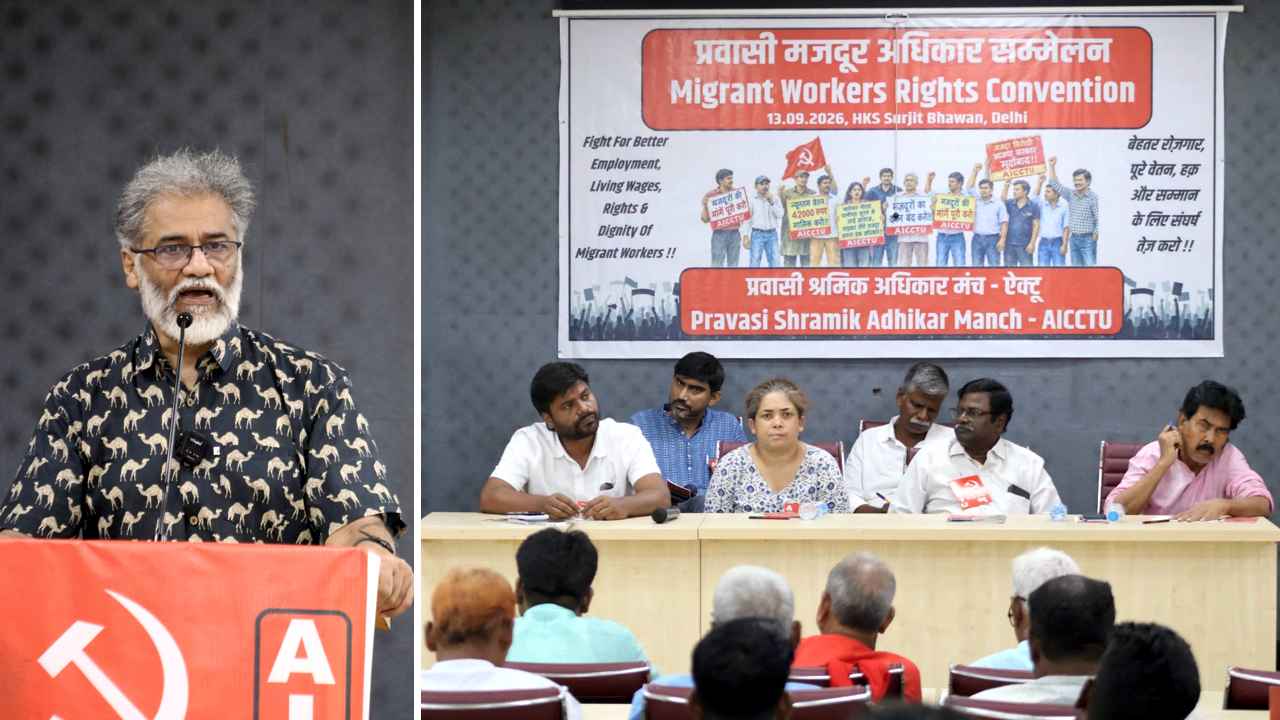
Historically, migrant workers have formed a significant part of the industrial working class, yet their vulnerability, insecure housing and employment, wage theft, unsafe working conditions and lack of political organisation often leave them among the most exploited sections of workers. India is home to an estimated 150 million migrant workers, constituting approximately 30% of the total workforce of 500 million as of 2025.
The last twelve years of the Modi regime has witnessed a steady erosion of workers’ rights, including that of migrant workers, through labour codes, SIR and a range of fascist laws and policies. The real exploitative conditions of migrant workers came to the fore during the Covid years. The unplanned lockdown led to the mass exodus of lakhs of migrant workers, which destroyed numerous lives and livelihoods. Ironically, Modi’s propaganda machinery has cleverly obfuscated his government’s lopsided policies and repeatedly convinced migrant workers to vote for his party in state and national elections.
Formed in this context, the Manch will strive towards the politicization of migrant workers. The Manch stands for the social, economic, political and cultural rights of all migrant workers— including registration and protection at workplaces, accountability of contractors and principal employers, safe housing and healthcare, timely return of workers who migrate, dignified repatriation of deceased workers, minimum wages, an eight-hour workday, social security, workplace safety, union rights and an end to discrimination and xenophobia.
Problems Faced by Migrant Workers
‘Noida just stopped pretending, the cracks were always there,’ read a placard during the workers’ protests in May/June 2026. The workers agitating against the 12-hour workday for a meagre Rs 10,000-12,000 a month were mostly migrants. Living in a perpetual cycle of poverty and precarity, the protesting workers exposed the socio-economic vulnerabilities of migrant workers. Low salaries compounded inadequate housing, deprivation of basic amenities, and ultimately spatial and social marginalisation in the destination states.
Despite their huge numbers, migrant workers face continuing exploitation, bondage, wage theft, unsafe working conditions and deaths of migrant workers across the country. The exploitation and oppression of migrant workers is enabled by the large-scale informalisation of work. 90% of India’s workforce is informally employed; a large majority of them through contractors. The contract system plays a key role in the employment and exploitation of migrant workers and their families including their children.
Workplace exploitation creates conditions wherein the rights of migrant workers as citizens are also rendered null and void. Their low bargaining power and lack of an organized social presence in their destination states means that they hardly have a political voice. At the same time, their absence from their homes for a large amount of time weakens their roots and voices in the home states. Thus, the migrant workers constitute a large army of informal labour, poorly protected by laws and policies and always at the mercy of the employers, contractors and the state.
Increasingly, migration is also tied to citizenship. All over the world migrant communities are being harassed under the guise of national security. In India, migrant workers are facing a large-scale disenfranchisement through exercises such as the National Register of Citizens (NRC), and the Special Intensive Revision (SIR) of voters’ lists. Irrespective of which government is in power, the state increasingly treats Bengali speaking migrant workers, especially Bengali speaking Muslims as a suspect community. The attacks on Bengali Muslim workers is however only one face of xenophobia. In many states, migrant workers from Bihar, Jharkhand and North-eastern states face attacks related to their language and identity.
The combination of socio-economic vulnerabilities and attacks on citizenship is creating a large pool of people who seemingly belong nowhere in a social and political sense. The irony is that while they face a crisis of belonging, their labour remains absolutely central to the economy.
Summary of the Deliberations
Comrades V. Shankar, Vinod Singh, Sandeep Saurav, Sucheta De, Mahboob Alam, Suman Das Mahapatra and Mohan constituted the Presidium for the convention. Comrade Akash presented the approach paper for discussion. The convention was addressed by trade union and peasant leaders from multiple states, most prominently from Bihar, Jharkhand, UP, West Bengal, Odisha, Karnataka, Tamil Nadu, Punjab, Uttarakhand and Delhi. Comrade Rajiv Dimri initiated proceedings of the convention and conducted election of the convening committee and a 7 member team of Coordinators. Around 140 delegates from 12 states joined the convention for the launch of Migrant Workers’ Rights Forum. The convention broadly accepted the urgent need for developing a sustainable movement of migrant workers in the current exploitative and repressive situation of migrant workers as the basis for the Manch (forum).
Dipankar Bhattacharya, CPI-ML General Secretary, inaugurating the convention, said that organising migrant workers is not new work for us, but in the present period it has become even more urgent. Calling for a comprehensive and united effort, he said that the Manch cannot limit its struggle to wages alone. It must also address political and social consciousness and questions of education, health, gender and other rights. He called for unified efforts at the home and destination states.
Dhirendra Jha, the General Secretary of AIARLA, echoed Com. Dipankar’s words and said, ‘In Bihar, we have discussed migration for a long time and have intervened whenever serious incidents have arisen, including incidents in Assam and fires in Delhi, and of course Covid. This gives us the base to launch this initiative.’
Viond Singh, the PBM of CPIML, emphasised on the need for our helping hands to Indian workers suffering in other countries as well. He also suggested a special team in Delhi to address such issues and maintain interaction with the governments.
Mahboob Alam, former MLA, welcomed the initiative and said that migrant workers need an organisation of their own. Earlier, groups of agricultural workers could work together in the fields; much of that work has disappeared, forcing people to migrate. The Government's attitude towards migrant workers is deeply indifferent. He said that language and citizenship have become additional sources of insecurity for migrant workers. Workers from Seemanchal and Bengali-speaking workers are frequently treated as outsiders or infiltrators. The citizenship question therefore has to be part of our work: what document is a migrant worker expected to produce to prove citizenship, and how will the organisation assist when that question is raised?
Mahendra Parida from Odisha mentioned that migration affects about fifteen districts in Odisha, with western Odisha particularly affected. Kalahandi is drought-prone and poor, and workers migrate to Andhra Pradesh, Tamil Nadu, Karnataka and other States. Malkangiri and Koraput are among the other affected districts. He noted, ‘AICCTU interventions in these areas have brought workers’ families into closer contact with the organisation. What we now need is a platform that can help tie all this work together.’
Shweta Raj from Delhi said the condition of migrant workers in mega cities like Delhi raises questions about urban planning. Flyovers and roads are being built everywhere, but the workers who build and run the city are not treated as part of the city's plan. Ten or twelve workers may share a single small room and even sleep in shifts. Where workers manage to build small homes, those settlements can be demolished. Women without Delhi identity documents have lost access to free bus travel. New ration cards are difficult to obtain, and existing entitlements can also be disrupted. The broader point is that transport, housing and ration must be treated as basic working-class infrastructure in every large city.
Sandeep Saurav, Bihar MLA, explained the reason for creating this Manch when migrant workers are already being organized under the banner of AICCTU. ‘The reason for creating a specific forum is that migrant workers are also being organised politically through their regional identity. The BJP has reached Bihari migrant communities through events such as Bihar Diwas and other diaspora networks, and even sections of our own traditional base have been drawn into those networks. We therefore need a targeted political and organisational response based on where workers come from as well as where they work. That response should not be limited to elections. Migrant workers should remain connected to the struggles and political developments in their home areas, and social media can be used for regular political communication.’
Clifton D’Rozario, Vice President of AICCTU, said there is very little systematic public understanding of migrant workers' issues, so we should issue statements, conduct studies and develop evidence that can be placed before society and Government. We also need a strong social-media team so that accidents, injustices and workers’ struggles do not disappear into a small newspaper report, he said. He also suggested that we should demand that 7 May be declared Migrant Workers' Day, in memory of the workers who were killed by a train while returning home on foot near Ahmednagar during the lockdown. By 7 May next year, we should prepare our demands and experiences in a concrete form and hold a large national programme, he said.
Several other senior leaders of AIARLA and AICCTU also addressed the convention along with many migrant workers.
V Shankar, the all India president of AICCTU, concluded the convention calling for building a sustainable and militant movement of migrant workers for their rights, dignity, security and benefits. He also shared views of other speakers to orient the migrant workers movement as a politico-social and trade union movement.

Major Decisions
- The organization is named as Migrant Workers’ Rights Forum in English and Pravasi Sramik Adhikar Manch in Hindi.
- The states will form their own migrant workers organisations suited to their requirement of the state. The Migrant Workers’ Rights Forum will act as a platform to integrate and coordinate all such initiatives all over the country.
- Various sub-groups including legal cell, research and study group, secretariat, etc., will be formed to take the movement forward.
- All the state units of AICCTU, AIARLA and AILAJ were urged to conduct surveys and prepare a state-specific charter of demands. These could then be unified into a national charter of demands.
- A membership campaign will also be conducted simultaneously with the surveys in Sep – Oct. It will be followed by organizing migrant workers conventions in major cities to be attended by leaders of Bihar, Jharkhand and other states.
- At an appropriate time, an elaborate campaign and protests will be organised on major issues of migrant workers.
- The Manch will demand to declare 7 May as National Migrant Workers’ Day. This was the day when migrant workers walking back to their homes during Covid (along a railway track) were run over by a train. On 7 May 2027 the Manch shall hold a National Migrant Workers’ Convention in Bangalore and adopt a national charter of demands.
- A 24 member Convening Body and a 7 member team of coordinators have been formed to operationalize the Manch.
Preliminary Demands
The convention adopted the following demands as preliminary demands as the basis of immediate interventions. These will be further streamlined when state and national charters of demands are finalized.
- All migrant workers must be registered at the point of recruitment and destination, with records of contractors, principal employers, worksites, wage terms, advances, accommodation and emergency contacts.
- Contractors and labour suppliers involved in deception, confinement, wage theft, bonded labour, child labour, unsafe work or violence must be prosecuted.
- Principal employers must be held liable for wage, safety and welfare violations in their establishments, including violations committed through contractors and sub-contractors.
- Article 23 of the Constitution, the Bonded Labour System (Abolition) Act, 1976, and the Child and Adolescent Labour (Prohibition and Regulation) Act, 1986, must be strictly enforced wherever migrant workers face attacks tied to labour, restriction of movement, withholding of wages, threats, assault, inability to return home, or employment of children and adolescents in hazardous work.
- Migrant workers must be guaranteed safe housing, drinking water, sanitation, health care, canteens, rest facilities, communication with families, and retention of identity documents, legal aid, return-home support, wage recovery and rehabilitation after rescue, injury or death. Provisions must be made for the education of their children.
- Provisions must be made for medical care of migrant workers in destination cities and states and their travel between their homes and destination states must be facilitated.
- International migrants, traveling at the behest of their employers, must be adequately insured. Adequate compensation should be paid in case of any work-related injury or death.
- As per Indian law and natural justice, the dead must be treated with dignity even if the person is a criminal or executed by the state. Yet migrant workers dying away from homes are treated with utmost disrespect. Provisions must be made for time bound and dignified return of dead bodies of migrant workers (intra-state, inter-state and international) to their families.
- A living minimum wage, an eight-hour workday, weekly holiday, double wages for overtime, ESIC, PF, safety protections and union rights must be guaranteed to all workers through strict enforcement and expansion of labour protections. Wage theft, Contractor Raj, unsafe work and the denial of collective organisation must end.
- All kinds of xenophobia against migrant workers, along lines of language, regional identity, religion and nationality must be stopped. In any exercise that may affect voting rights, special arrangements must be made to ensure that migrant workers do not fall through procedural gaps.
--------------------------
Convening Body of Pravasi Shramik Adhikar Manch
Convenor:
1. Akash Bhattacharya
Coordinators:
2. Vinod Singh
3. Sandeep Saurav
4. Uday Bhat
5. Virendra Gupta
6. Mehboob Alam
7. Suman Das Mahapatra
Members:
8. Surya Prakash
9. Bhuvaneshwar Kevat
10. Santosh Rajak
11. Sadrul Sheikh
12. Kalpesh Nadkarni
13. Vandana
14. Satyadeo Ram
15. Devendra Sahu
16. Mohan
17. Jaiprakash
18. Mahendra Parida
19. Paramanand Hans
20. Ram Singh
21. Amar Singh
22. Ibrahim
23. Arindam
24. Saurabh Naruka.