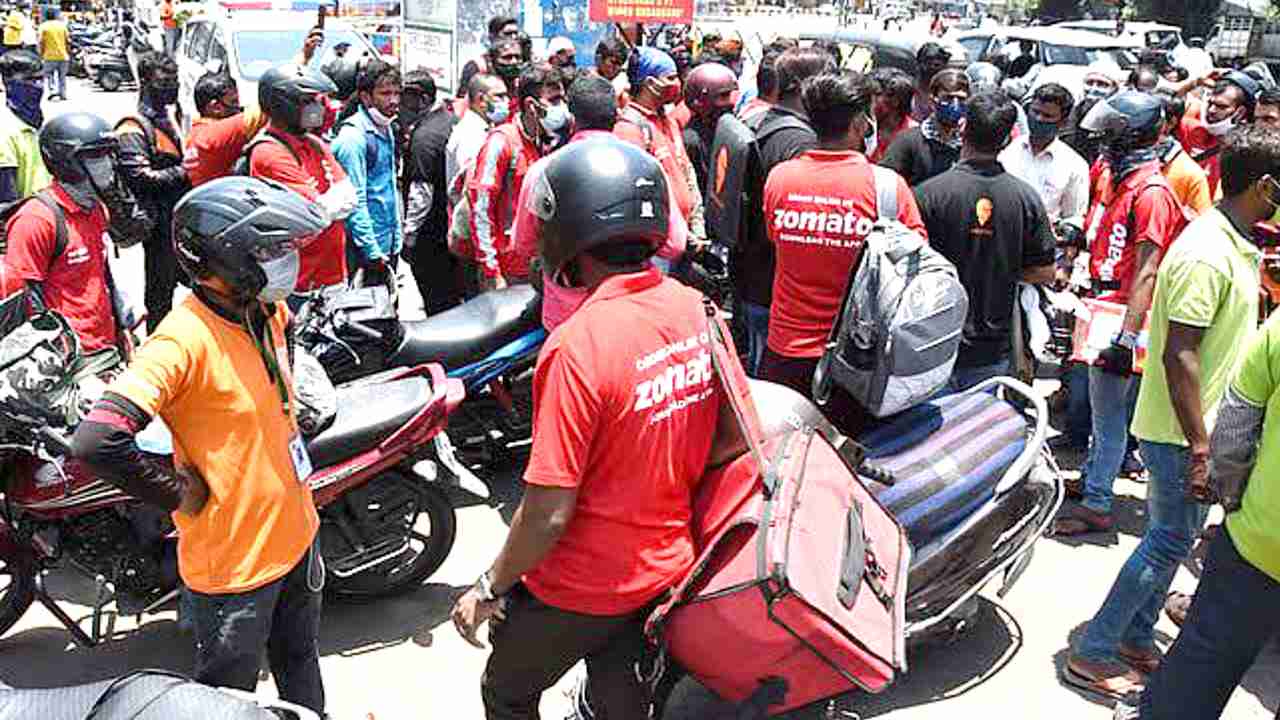
Like traditional e-commerce, quick commerce operates a double-sided market: not only are customers charged for products, but sellers are charged for product placement, ads and positioning. But, an even more elucidating lens to view these platforms and companies’ operations in India is as a triple-sided market: gig workers, as non-employees, delivery “partners” are charged onboarding and other fees in order to be able to access work.
Progressive worker movements across the world have realised that this flexible delivery workforce and their exploitation poses a new scale of challenges related to wages, working conditions and social security. A new research project, GigSaathi , was launched with the motivation to understand the algorithms that shape the earnings and related payment ‘incentives’ for delivery workers in the quick commerce sector.
Algorithms are not just used to determine pay, but also for task allocation and automatically reviewing performance. These algorithms, aimed at fulfilling demand while optimising the company’s profits, are a black box to the workers and public. This creates a unique dynamic of information asymmetry between the gig workers and the platforms.
GigSaathi aimed at bridging this asymmetry by directly collecting and analysing wage and incentive data from delivery workers associated with BlinkIt, the largest company in this space commanding almost half of the market share. Delivery workers from multiple BlinkIt stores shared screenshots of their pay-out pages with the research team, which they collated and analysed for trends.
The research team found that wage-setting is opaque and complex, calculated by a mix of algorithms and some manual controls by local managers. The latter comes into play when specific conditions arise at the level of a store or neighbourhood, say heavy rain or worker strikes.
First, an aspect that is intuitively understood by workers, for which we found concrete evidence of, is that there is no correlation between earnings and time spent on a delivery order. A significant proportion of workers’ earnings is determined by invisible factors that are never reported to them and are difficult to compute based on the information they have. On average, workers earn approximately INR 48, travel around 5 kilometres, and spend approximately 20 mins per order. However, these had very high variations. By disregarding time spent per order, pay-out algorithms do not factor in multiple challenges and hurdles in workers’ ways: traffic, security at housing societies or residential complex, rules that restrict ‘outside’ vehicles to a gate that is far away from the apartment, travel up flights of stairs, and casteist limitations around lift use.
Second, incentives made up on average about 24% of the total weekly earnings of a worker. Incentive pay is determined weekly – and often daily – based on supply of workers and customer demand. These are paid when workers meet certain conditions (number of orders delivered in a day or during certain hours, etc.). The incentives are clearly meant for labour control and have high variability. In fact, higher earnings per order correspond to a lower share of incentives in total earnings, and vice versa.
This creates significant wage fluctuation for gig workers, and is one of the main levers through which companies ‘push’ and ‘pull’ workers into their dynamic labour pool. Wages are regulated through gamified features making it difficult for workers to keep up, and they are always ‘playing’ to maximise their incentives. Work is intensified without any guarantees of higher pay, keeping workers running on the hamster wheel to meet incentive targets.
The research stipulated that apart from the treatment of delivery work as contractual labour, other factors – including opaque wage determination, and complex labour controls – contribute to fracturing the workspace, and creating a severe impediment for worker organisation. The Karnataka Platform-Based Gig Workers Act of 2025 provides a small glimmer of hope in requiring platforms to be more upfront about these factors, but is not operational in toto. The fight continues on many fronts around worker conditions and wages, transparency around these systems will allow workers and their unions to make more authoritative claims and strategic decisions around actions and demands of companies and governments.
====
App Karamchari Ekta Union (AKEU), affiliated with All India Central Council of Trade Unions (AICCTU), has been raising the demands of gig workers, and particularly of delivery workers of quick commerce platforms like BlinkIt, Zepto and Instamart. The union has intervened in Delhi in incidents of store managers outright harassing and physically assaulting workers for demanding better wages.
The union actively demands extreme weather compensations (in heatwaves and floods) for the delivery workers, and a petrol and mobile internet allowance for the workers in the current conditions of soaring inflation.
The union’s recent on-ground interventions also secured partial payments of wages owed to packers associated with Zepto. This emerging class of workers face unique forms of precarity and exploitation, demands better working conditions and wages, and legal changes that can guarantee their rights.