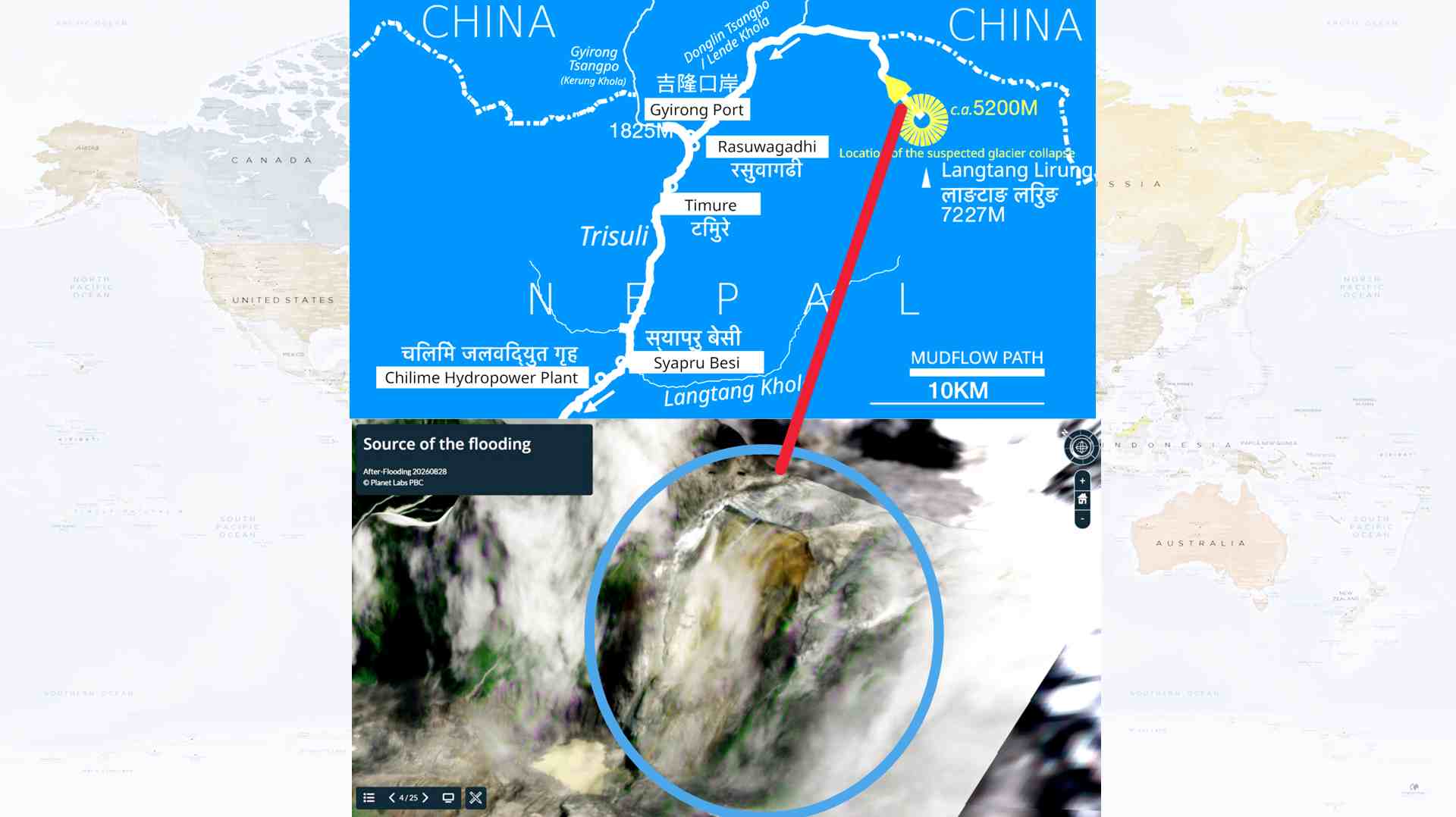
The flood in Nepal originated in a massive block of the Langtang Lirung glacier breaking off and falling down more than a thousand meters, on the valley floor below. The mass of ice and rock debris was so great that the impact was mistaken for an earthquake. This impact set off the gigantic wave that caused havoc throughout the Bhote-Koshi valley. Unfortunately, similar incidents have happened earlier, with the Chamoli disaster (Uttarakhand, 7th February, 2021) being the most well-known. A similar rock and ice avalanche had caused a flood in the Rishiganga Valley which killed more than two hundred people and destroyed two hydropower projects. One of these hydropower projects – Tapovan-Vishnugad – was cleared for re-construction just six months after the disaster, along with five more. The fact that an area established to be at flood risk was cleared for dam construction makes it clear that building dams has become a greater priority than human lives and wellbeing. Chamoli particularly, suffers more due to its position as a major junction on the road towards the India-China border – devastating constructions have been waived off as military requirements for national protection. These construction projects have been identified as the root cause of the massive land subsidence in Joshimath – the town sank about five centimeters over twelve days. While the National Thermal Power Corporation (NTPC), responsible for these massive construction projects spends its time trying to portray local private construction and tourism for the land subsidence, over five hundred more towns sit in subsidence-risk zones. Chamoli district alone, hosts about fifty hydropower projects.
The obsession for “development” in risky areas is an obstinate threat, a unifying desire across political parties, governments, and even nations. After all, each signature on each clearance level for a massive project comes with massive financial perks for the signatory. The risk remains for the people living in (or being displaced from) the construction area. The refusal to restrict clearance despite risks is probably most clear in the case of Sikkim’s Teesta-III hydropower project. Since 2005, Affected Citizens of Teesta, an indigenous advocacy group, had warned about flood risks in the Teesta valley, as the South Lhonak Lake had swollen to dangerous levels. On 4th October, 2023, a permafrost landslide dumped about fifteen million cubic metres of rock and ice into the South Lhonak Lake. The resulting wave breached the moraine, releasing roughly fifty million cubic metres of water and eroding 270 million cubic metres of sediment. It killed 129 people and destroyed the 1,200MW Teesta-III dam.
Teesta Urja (now Sikkim Urja) built the dam on a build-own-operate-transfer basis — 60% Sikkim government, the rest split between Athena Projects, Asian Genco and PTC India. The ₹13,965 crore project was debt-financed by a consortium led by two central government lenders, the Power Finance Corporation and the Rural Electrification Corporation. Earlier still, Western private equity — Morgan Stanley Infrastructure Partners, General Atlantic, Goldman Sachs Asset Management, Everstone Capital, and UK-based Ashmore — held equity through a holding vehicle and had already exited. The project was also registered under the UN's Clean Development Mechanism to earn carbon credits as a "clean" project, a classification watchdogs called fraudulent since the dam would have been built regardless of the carbon financing. The profits went to the central lenders who could count on the generated interest, and the private equity investors who structured and exited before 2023, regardless of what happened after; whoever brokered the carbon credits.
Disasters in Himalayas however, cannot be only seen as the fallout of money-making interests. Expansion of infrastructure is also a weapon of the expansion of Hindu majoritarian politics of current times.
Days of extreme rainfall, compounded by rapid snow/glacial melt and the collapse of the moraine-dammed Chorabari Lake above the town, sent a debris-laden flood through Kedarnath and the wider Mandakini-Alaknanda system (16th June, 2013). Estimates of the dead and missing run above 4,000, making it one of the deadliest Himalayan disasters on record. A Supreme Court bench had reserved judgment on a hydropower environmental-clearance case in the same river basin one month before the disaster hit — and went on to note the "mushrooming" of hydro projects, tunnelling, muck disposal and blasting across the Alaknanda and Bhagirathi basins as a likely amplifier. In August 2013, the Court froze all new hydro clearances and ordered an expert review. That freeze did not hold: it took until May 2026 — thirteen years and at least four more major disasters in the same basin (Chamoli 2021, Joshimath 2023, Dharali 2025) — for the central government to finally tell the Court it opposed any new hydro projects in the Alaknanda-Bhagirathi system beyond seven already committed. Kedarnath is one of the Char Dham, so its reconstruction was never just an engineering project. It became a high-visibility signature project associated with Prime Minister Modi personally — he has visited repeatedly, and in May 2019, on the final day of national election polling, he meditated overnight in a cave near the shrine, an event covered heavily by national media. While such electoral shenanigans have kept the BJP’s Hindu vote flow alive, it is the locals and the seasonal workers — pony operators, porters, dhaba owners — who service the pilgrims who now face extra risk from the expanded Char Dham infrastructure in an established fragile area.
The Char Dham infrastructure, a flagship of the Hindu majoritarian project, has caused more disasters across time and space. On 5th August 2025, a flash flood hit Dharali (Harshil Valley, Uttarakhand). The valley had filled with hotels built to serve the fast-growing Char Dham pilgrimage trade, resulting in commercial construction sitting directly in the flood's path. Five people died and a hundred are still missing. The ₹12,000 crore, 889 km Char Dham Highway is declared by the government to be dual-purpose: pilgrimage tourism and troop/missile-equipment movement to the India-China border. When environmentalists challenged the road-widening in the Supreme Court, the Ministry of Defense intervened directly, and the court ruled that the width standards for "strategic" segments couldn't be second-guessed against military necessity. Pilgrim presence has burgeoned, as has the pockets of NHIDCL's private road-building contractors. Natural disasters like cloudbursts or flash floods may come without warning, but putting more people in the path of disaster is an informed irresponsible choice for the sake of political prestige.
Similar Hindu majoritarian projects have claimed lives elsewhere. A cloudburst hit Chisoti village during the Machail Mata Yatra pilgrimage (August 2025), killing seventy people, and injuring three hundred, with dozens missing. Roads had been recently extended all the way to Chisoti, specifically to grow pilgrim volume. Until a few years ago, pilgrims walked the entire route. Kishtwar's own district administration and allied media have explicitly and publicly framed this as a deliberate strategy: an August 2026 feature (in Organiser, a publication aligned with the Hindu nationalist movement) described Kishtwar's transformation "From North India's Power Capital to North India's Religious Tourism Hub," crediting the Machail Mata Yatra as "the driving force" of that shift — published a full year after the cloudburst killed dozens of pilgrims on the very route being promoted.
The infrastructure, therefore, cannot be taken as an experimental mistake on the government’s part, stemming from the government’s innocent desire to only serve citizens. The abrogation of article 370 in 2019 has acted as an effective tool to change Jammu and Kashmir’s demographic. The infrastructure expansion in the name of development for pilgrimage is part of the same majoritarian agenda.
Hindu majoritarian politics trash India’s own mountains while claiming to save the Hindu’s in danger, but the same government adopts foreign policies putting more people at risk. China has financed and built hydropower and infrastructure in Nepal since roughly 2010 as part of its wider Belt and Road push; the Pokhara International Airport (~$216 million, financed by a loan from China's Export-Import Bank) is the most-cited example, and is now widely reported as underused and unable to service its own debt. India, in turn, changed its own power-purchase policy in 2018 to explicitly refuse to buy electricity from any Nepali hydropower project with Chinese investment — using market access as a geopolitical lever against Beijing's presence, not for any stated technical reason. India has since won far more Nepali hydropower operating contracts than China (10 vs. 5, per 2023 reporting). Nepal, sandwiched between two much larger powers competing for hydropower influence, has strong incentive to approve rapid, competing infrastructure build-outs across fragile Himalayan valleys — exactly the terrain where Thame, Rasuwagadhi, and the 2026 Langtang Lirung disaster all befell — without the kind of coordinated, cross-border hazard monitoring a less contested border region might manage. The Rasuwagadhi/Trishuli corridor is not incidental infrastructure; it is the literal trade and hydropower artery this India-China competition was built around, and it has now flooded catastrophically twice in thirteen months (July 2025, August 2026). Chinese and Indian state-linked engineering and financing firms have clear benefits, whichever government scores the geopolitical win of influence in Nepal. Nepal's own political and NEA elites navigating the contracts also win. The ones to lose, in all scenarios are the rural communities in the fastest-building, least-monitored valleys, and Nepal's broader economy — tied on one side to an export market (India) that can cut it off with a unilateral policy change, and on the other to debt-financed connectivity (China) whose repayment burden lands on the Nepali state regardless of whether the project ever performs.
In the discussion so far, we have implied climate change is a fact of nature, an apolitical force, and we must adapt our climate change related disaster responses accordingly. We should be clear that this is not at all the case. Climate change may have been driven historically by the developed nations, but the changed climate affects tropical nations like ours disproportionately. Developed countries are responsible for nearly 80 per cent of global cumulative carbon emissions over the last two centuries, while hosting only fourteen percent of the global population. South Asian countries all rank in the twenty nations most vulnerable to climate change. In just the last decade, human mortality due to climate change related disasters was fifteen times higher than in less vulnerable, developed countries. Even a small warming causes our glaciers and permafrost to melt faster, our weather to behave more chaotically. Recent studies show that if current emissions continue, the Himalayas could lose up to eighty percent of its glaciers – directly affecting 240 million people in the mountains and over 1.5 billion people in the valleys below. And hence, India cannot keep campaigning on the global stage for relaxations to emissions, but should rather use its economic and strategic strength to enforce strict emission norms. The past few climate summits have mostly been a fervent campaign by world leaders to scuttle emission norms for the sake of non-renewable energy interests. The ruling government’s irresponsible actions towards the global and Indian environment surely benefit corporations like Adani who are all too happy to be in both mining and power plant business at the same time. In a time where public transport needs to be developed to ensure most people can move around with least emissions, the ruling governments across India seem to be obsessed with encouraging private transport and associated infrastructure (e.g. a tunnel road in Bengaluru disguised as a congestion relieving mechanism). The central government has attacked the Indian railways’ passenger trains (while celebrating a few Vande Bharat trains). India can not afford to take insufficient environmental protection measures. It is us who are most at risk from climate change related disasters. And India has enough scientific and technical capability and creativity to develop climate solutions. Climate change is not a lost cause unless we decide to give up on ourselves. And as the recent movement across the nation showed, it is better to give up on leaders who have given up on everyone but themselves than to die silently in masses.