10 Years of Chorus Cultural Group
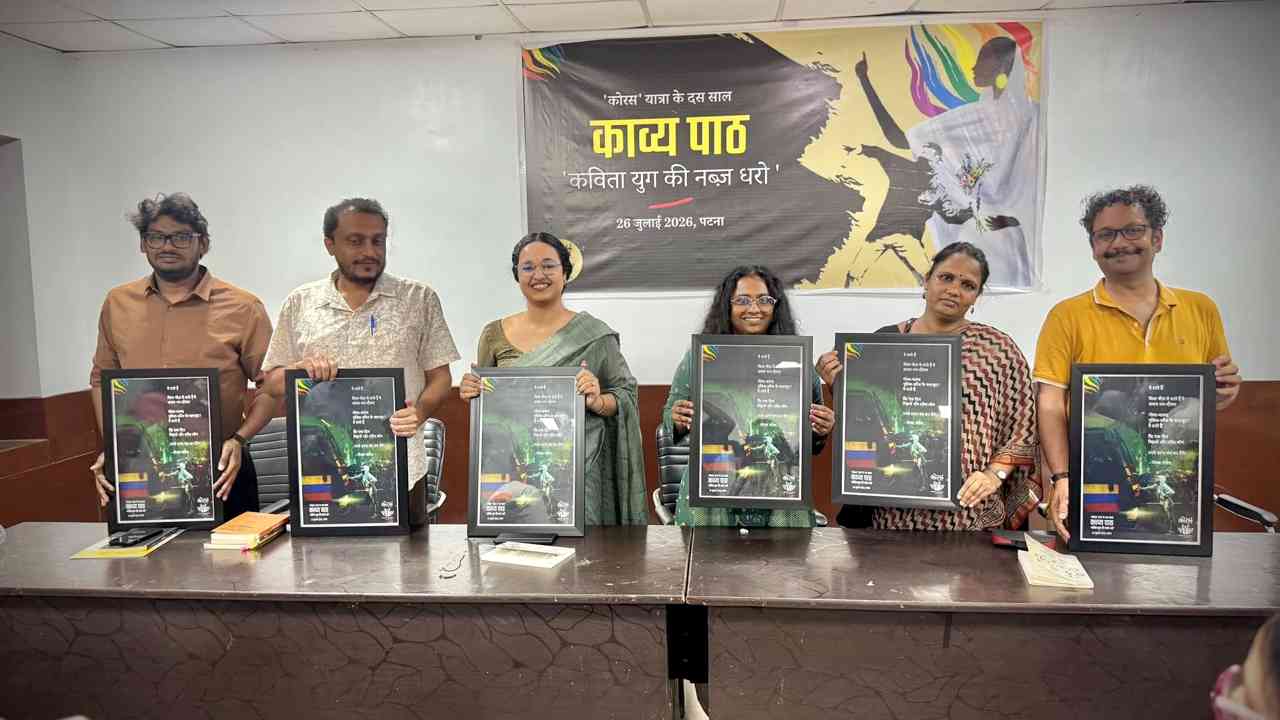
To mark the completion of a decade of its journey, Chorus organized a poetry reading session in Patna on July 26, 2026, at the IMA Hall, Gandhi Maidan, Patna. The theme of this event "Feel the Pulse of Our Times through Poetry," (kavita yug ki nabz dharo) was an expression of youthful, defiant voices standing firm against a repressive culture. This gathering featured some of the prominent voices representing the collective conscience of the 21st century with tools of linguistic resistance against an inhuman system which is also causing severe devastation to our environment.The highlight of the event was the participation of young poets from various corners of the country, giving voice to virtually all marginalized experiences, poets who have cultivated their own distinct vision to perceive the world anew. At a time when the repressive forces loom large with conspiracies and violence, striving aggressively to establish their hegemony through every conceivable anti-human instrument, there are still those who drown out their hateful clamor with the strumming of a tambura, who share their hunger with the stray cats of desolate cities, and who laugh at engineered fear even as blows rain down upon them. These young poets are among those very people.
People from the city poured into an auditorium in Patna to listen to the poetry, chairs fell short, and there was not even standing room left. This demonstrated the enduring resilience and spirit of resistance inherent in the city of Patna - a shared consciousness that, in such barbarous times, continues to place its faith in unbridled, radiant voices, and holding the dream of liberation as an inalienable right.
First to take the stage was Adnan Kafil Darvesh, a young poet honored with the Bharat Bhushan Agarwal Award, who recited poems. His poetry serves as a luminous counterpoint to the darkness of fascism in our world. His verses summon the aspirations of children who yearn for a complete, radical transformation of this society.
As the second poet, Anupam, from Delhi, recited poems offering a profound critique of the social conventions woven from body to mind by a society that regards women as natural subordinates. Anupam's poetry brings forth a civilizational critique in opposition and dreams of a society where women and men share equal partnership in material world, politics, and love, a world where a woman has the freedom to sculpt herself as a human being, the primary precondition for which is the reshaping of man.
A young poet from Allahabad, Shivangi Goyal’s poetry expresses her raw fury with merciless honesty, refusing to conceal tender sensitivities, desires, wounds, and abrasions.
Vihag Vaibhav, also honored with the Bharat Bhushan Agarwal Award, has recently returned from a prestigious translation workshop held at a university in Denmark. His poems underline the fight for identity and dignity is a struggle to change the entire world, articulating the unification of different identities in a sharp, aggressive register. He asserts that in the perilous, fascist world we inhabit, there is no room for those who fail to resist.
Poet Rupam Mishra recited many poems vividly bringing alive the reality of rural life. She expresses the silent resistance of women against an oppressive patriarchal society. Her poetry captures the transformative power of love capable of challenging this era of hatreds, while a mother, dreaming of a beautiful world, draws strength from her children. Rupam views the world through this very lens in her verses.
Presiding over the event, the poet and critic Mrityunjay observed that in these perilous times all oppressed identities and voices of resistance must converge in order to forge a shared path. And this very path is being carved out by a new generation of poetry. He also recited poems "Chemotherapy" and "Gaza."
Throughout the poetry readings, members of Chorus presented musical renditions of poetry. Notable musical performances included Nirala’s Gahan hai yah andhakara (Deep is This Darkness), Raghuvir Sahay’s Padhiye Sita (Read Sita) and Virendra Dangwal’s Hamara Samaj (Our Society). The vocals were rendered by Samta Rai, Runjhun, Riya, and Rita, accompanied by Jyoti on the guitar.
On behalf of the organisers, poets Anchit, Nivedita Jha, Gunjan Upadhyay, and Pratyush Chandra Mishra honored the guests with beautifully crafted poetry posters. Runjhun, compered the program in a lyrical way. Samta Rai, Secretary of Chorus, expressed her gratitude to all the participating poets and the listeners in the audience which included a large number of intellectuals, literary critics, artists, academicians and cultural activists including poets Alokdhanwa and Madan Kashyap; critics Ramji Rai and Siyaram Sharma; Manoj Singh, National General Secretary of Jan Sanskriti Manch; sharp critic Pranay Krishna; social scientist Vidyarthi Vikas; poet Kaushal Kishore; Sanjay Joshi from Pratirodh Ka Cinema; poet Ranjeet Verma; poet and writer Sanjay Kumar Kundan; poet Kumar Mukul; fiction writer Santosh Dixit; writer Sushil; social workers Madhubala and Sushmita; senior theater artist Zahoor Alam; Rajkumar Soni from Chhattisgarh; Ajay Kumar, Feature Editor of Prabhat Khabar; Jitendra Kumar from Arrah; litterateur Shahanshah Alam; poet Rajesh Kamal; writer Prabhat Parineet; poet Ramesh Ritambhar and young poet Tanuj from Banaras, among others. Poets Arvind Paswan, Nikhil Anand Giri, Krishna Sammiddh, Prabhat Jha, Shovan, former JNUSU President Nitish, poet Matrisharan Priyadarshi, and Naushad Raza, a research scholar from Aligarh Muslim University, were also present.