
This
is an abridged edited version of the essay,‘What Links Jantar Mantar
with Noida’ published on the Research Unit for Political Economy (RUPE
India) blog on 30 July 2026.
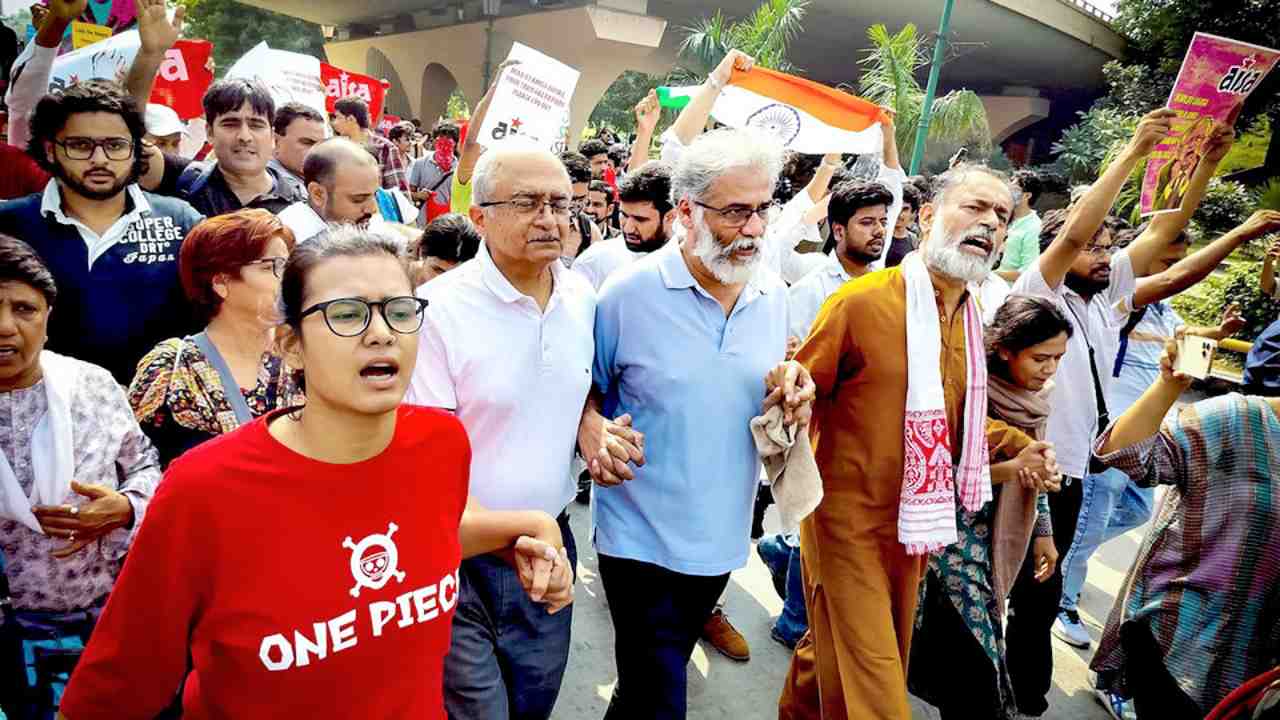
The immediate demands of the recent student-youth rallies in Delhi and elsewhere related to the incessant leaks of examination papers. But the remarkable surge of participation in these protests showed that this movement had tapped widespread anger among the youth beyond just the question of leaked papers. The discussion of these events has largely focussed on the nature of this generation of youth, their modes of expression, and so on. But we need to shift the focus to the objective reasons for their anger.
India’s
youth have much to be agitated about. They confront a privatised and
expensive education system which does not yield them jobs; the
disappearance of jobs that are worth the name; and declining real wages.
All three phenomena are clearly the outcome of the economic policies
followed in the neoliberal era.
Higher education as a method of extracting the meagre resources of working people
Sixty years ago, the Kothari Commission recommended that public expenditure on education should be 6 per cent of GDP, and successive governments ever since have paid lip service to this target. The New Education Policy of 2020 repeats the 6 per cent target, but the combined spending of the Central and state governments is stuck at around 2.7 per cent of GDP.[1]
Neoliberal policy opposes any increase in public spending,
arguing that the private sector is more efficient at delivering the
goods. But the private sector enters education only if it finds it
profitable, for which it charges higher fees; so the burden on
households grows. Household spending on education is increasing faster
than public spending on education. Within total household spending, the
share of spending on education more than doubled between 1990-91 and
2017-18.[2]
Let us look specifically at higher education, in the
context of the recent protests. A timely and thorough study, The State
of Working India 2026 (SWI), by the Centre for Sustainable Employment at
Azim Premji University, Bangalore, provides many insights. Unless
otherwise attributed, the data given below are from this study.
Over
the last few decades, a larger section of Indian parents have nurtured
the hope that their children will enjoy a better life than their own.
They are aware of the ‘graduate premium’, i.e., the fact that college
graduates on average earn more than those without college degrees. And
so families have sent their children to college in sizeable numbers in
the post-1991 era, particularly since 2000. The number of college
graduates has risen by 100 million (from 49 mn to 149 mn) over the past
20 years. Even those with meagre resources have scraped together the
funds to pay college fees, private tuitions and other costs. Nearly a
third of India’s college students are now drawn from the poorer half of
the population. (Of course, poor households are unable to place their
children in the courses which yield higher wages, such as medicine.)
Demand
for higher education has thus risen steeply. However, as we mentioned
earlier, in the post-1991 neoliberal era the Government restrained
spending on higher education, and so a growing market was handed over to
the private sector. As The State of Working India remarks, “This new
and burgeoning demand made higher education an attractive investment
option”. The number of higher education institutions has grown rapidly,
to 69,534 today; but while the public sector accounted for half of
higher education institutions till the 1980s, the private sector now
accounts for over 80 per cent.
This growth in the private sector has
been accompanied by a decline in quality, reflected in the worsening
student-teacher ratio. A recent survey cited by the Government claims
that only 55 per cent of India’s college graduates are ‘employable’;[3] a
2019 survey found that 80 per cent of engineering graduates were not
employable in any job in the ‘knowledge economy’; and a TeamLease survey
in 2024 claimed only 10 per cent of the 1.5 million engineering
graduates that year would land jobs.[4] This is after households who send
their children to engineering colleges each spend over Rs 70,000 a year
on fees and other expenses.
Only a third of graduates get salaried jobs
The central problem, however, is not the supply of adequately skilled labour, but the demand for labour: not enough jobs are being generated. That is, there is a general employment crisis, within which there is a crisis of graduate employment. While India’s colleges have turned out 100 million graduates over the last 20 years, only 56 million of them found employment, and only 34 million of them got salaried jobs, implying that the other 22 million ‘employed’ graduates were consigned to self-employment or casual labour. Just one in twelve college graduates gets employed in a role matching their education.[5] A 2022 survey by the National Council for Applied Economic Research found that a third of food delivery platform workers had college degrees or above.[6]
Since
many graduates are competing for a handful of salaried jobs, employers
have the upper hand. The growth in monthly salaries of graduates has
flattened since 2011; indeed, in the case of male graduates, real wages
(i.e., wages after discounting for inflation) have fallen outright since
2011.
By the definition adopted in India’s official surveys, “persons who are engaged in any economic activity” during the relevant period are considered “employed”, whether or not their employment fully employs them or yields them a living. This means that a rise in employment can take place even as conditions actually worsen. For example, in a situation of distress, a family may throw as many as it can onto the labour market, however little each may earn. Thus in the last six years, women have joined the workforce as unpaid helpers on family farms. And young men have left education to take whatever work they can get, in order to support the household. These are signs of desperation among labouring families, but the same data are then trumpeted by the Government as a rise in employment rates and a rise in women’s participation in the workforce.

Chart 1: Graduate employment has not kept pace with the supply of graduates. (State of Working India 2026, p. 132.)
The employment crisis and the pattern of growth
Why are there not enough jobs? This is a much broader question, which needs a deeper exploration than is possible here. At the heart of it is the entire pattern of growth. The absence of a revolutionary transformation of agrarian relations after 1947 prevented the widely-dispersed growth of demand, and prevented the emergence of a widely-dispersed, labour-intensive industry catering to that demand by making humble items of mass consumption. As a result, workers were not drawn out of agriculture into manufacturing. Employment in larger private firms (the ‘organised sector’) grew slowly; in 1991 it was still only 40 per cent as large as public sector employment. And public investment itself grew too slowly to absorb all those who had acquired education and training.[7]
When
growth did take off in the 2000s, it was driven by the demand of the
top 5-10 per cent of the population, who consumed high-end goods and
services made with capital-intensive technology, requiring large
imports, and requiring less labour. The construction boom did cause the
growth of construction labour, but this was in sweated, low-paid jobs.
At any rate the construction industry has been limited to infrastructure
and luxury housing, not housing for the masses, who lack purchasing
power.
Meanwhile public sector employment proper, composed of directly employed workers who enjoy some job security and decent wages, has fallen outright in the neo-liberal era.[8] The public sector’s share of total employment fell from 5.2 per cent in 1993-94 to 3.7 per cent in 2011-12.[9]
As the agrarian crisis has intensified, agricultural
households have sought to supplement their meagre farm incomes with
meagre incomes earned in casual labour, low-paid service jobs (e.g., as
security guards), petty retail, and various types of self-employment –
all expressions of distress. This model of development has not
essentially changed even as governments have changed hands from the
Congress to the BJP over the years.
Now, with changes in the global
economy, the better-paid jobs in IT have stopped growing and, owing to
AI, may shrink, with repercussions for many sectors. The employment
crisis is set to worsen, and today’s youth – both those with college
degrees and without – will have to think about what changes need to be
brought about to overcome it.
(Full article: https://rupeindia.wordpress.com/2026/07/30/what-links-jantar-mantar-with-noida/)
References:
1. Economic Survey 2025-26, p. 519.
2. Household
spending on education rose from 1.5 per cent of GDP in 1991-92 to 2.7
per cent by 2017-18. The share of total household spending (Private
Final Consumption Expenditure) spent on education more than doubled,
from 2.1 per cent to 4.4 per cent over the same period. —
Venkatanarayana Motkuri and E. Revathi, “Private and Public Expenditure
on Education in India: Trend over Last Seven Decades and Impact on
Economy”, Indian Public Policy Review 2024, February 6, 2024.︎
3. Cited
by Minister of State for Education, Sukanta Majumdar, in reply to Lok
Sabha Unstarred Question no. 1260, December 8, 2025.
4. TOI
Education, “Pursuing engineering once a fad, now a dilemma: Only 10
percent of 15 lakh graduates likely to land jobs this year”, October 29,
2024,
5. Institute for Competitiveness, Skills for the Future: Transforming India’s Workforce Landscape, p. 23.
6. National
Council for Applied Economic Research, Socio-Economic Impact Assessment
of Food Delivery Platform Workers, August 2023, p. 21. The NCAER found
that 32.7 per cent of food delivery platform workers were college
graduates and above; 3.6 per cent were technical graduates; and 1.3 per
cent were vocational graduates.
7. In 1983 itself, the unemployment rate among young college graduates was 35 per cent. – State of Working India 2025-26, p. 172.
8. R.
Nagaraj, “Public sector employment: What has changed?”, Indira Gandhi
Institute for Development Research, November 1, 2014.
9. Public sector employment was 19.4 million in March 1994, out of a total workforce of 374 million; it fell to 17.3 million in March 2012, out of a total workforce of 474.2 million. (Economic Survey 1999-2000 and 2016-17 for public sector employment in 1994 and 2012, respectively; for total workforce in 1993-94 and 2011-12, Santosh Mehrotra et al., “Explaining Employment Trends in the Indian Economy, 1993-94 to 2011-12”, Economic and Political Weekly, August 9, 2014. More recent Economic Surveys do not provide data regarding public sector employment.)