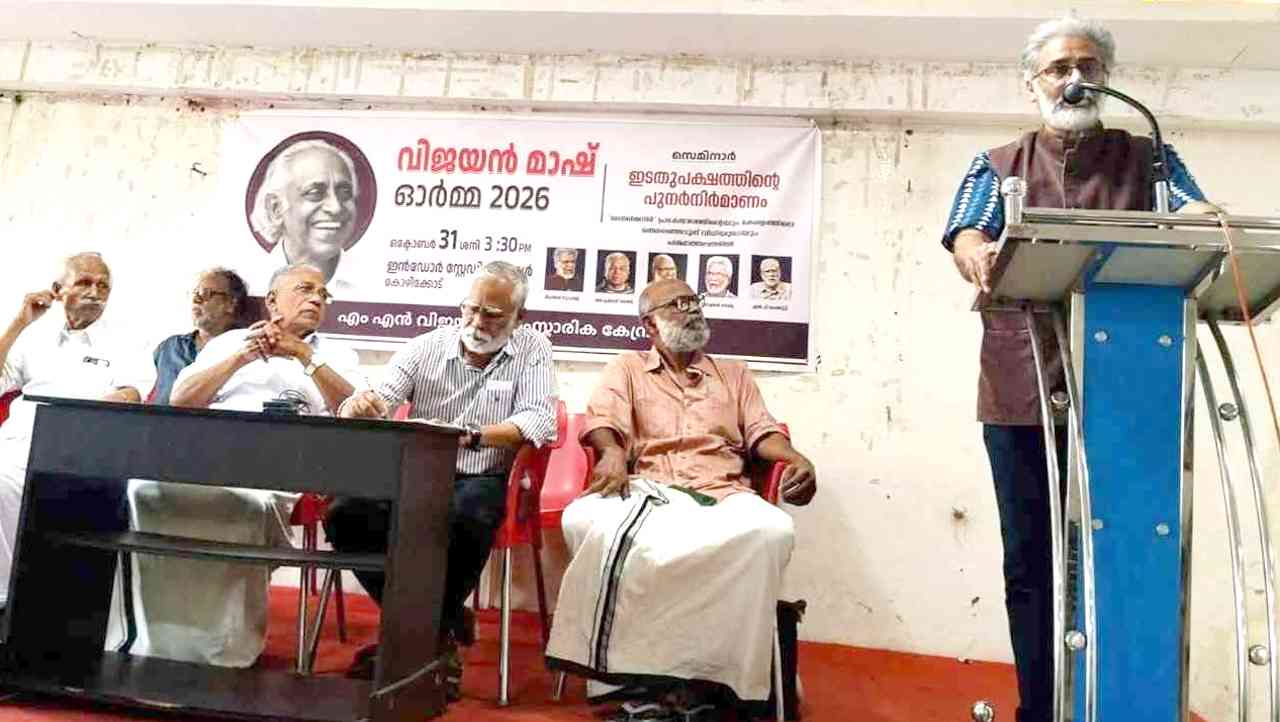
The following is a slightly abridged version of the keynote address delivered by CPIML General Secretary Dipankar Bhattacharya at the Vijayan Maash Memorial Seminar organised by the M. N. Vijayan Cultural Centre in Kozhikode, Keralam, on October 31. The seminar focused on the theme “The Rise of Indian Fascism and the Challenges Facing India and Keralam.”
To the chair of this symposium, Comrade Chekkutty, Comrade Prakash Babu, the speakers to follow, and all of you present here—friends and comrades:
It is a great privilege for me to address you on this occasion, which is dedicated to the memory of Professor M. N. Vijayan. Unfortunately, I never had the opportunity to meet him in person. However, I have heard much about him. As we were just reminded, in the final years of his life, he served as an independent, critical voice contemplating an alternative, more meaningful future for the Left in Keralam—a vision that I am sure applies to the broader Indian national context as well.
To draw a brief analogy, we saw a similar dynamic in West Bengal in the early 2000s with Comrade Ashok Mitra, the Marxist economist who served as the first Finance Minister of the 1977 Jyoti Basu government. He, too, began criticizing several Left Front policies around early 2006, particularly the land acquisition in Singur.
Fundamentally, that entire critique—whether developed by Ashok Mitra and his comrades, or by Professor Vijayan here—emerged in response to the growing impact of neoliberalism on our economic policies, and the question of how the Left ought to confront it. Whenever they observed signs of surrender, vacillation, or unacceptable compromise with neoliberalism, they consistently raised their voices to express concern and critique that trajectory.
All of them shared the same political setting, where we could assume some degree of parliamentary democracy, a welfare state, and a mixed economy. Those were the baseline conditions. Whether we aimed for an outright revolutionary transformation or sought to exert pressure on the system to keep it in check, the underlying context remained the same: parliamentary democracy, a mixed economy, and a direction set by the state.
The introduction of new economic policies—liberalization, privatization, and globalization—in 1991 marked the first major shift. Economic policy began changing abruptly. Alongside this shift, the 1990s brought other profound upheavals: the aggressive rise of the BJP and the Ramjanmabhoomi agitation. That was a major shake-up in Indian politics—an earthquake developing across the country.
In the popular terminology of that era, politics was known as 'Mandal politics,' 'Mandir politics,' and 'Market politics.' Many believed that the market and the new economic reforms would naturally neutralize extreme communal polarization, hysteria, and fanaticism. That was the prevailing assumption in the early 1990s. The critiques offered by M.N. Vijayan and Ashok Mitra in the early 2000s emerged after a decade or two of experiencing those policies. Today, in 2026, we have entered an entirely new and unprecedented phase—one we must clearly name as Indian fascism, nothing less.
Fascism in India has now come to power. As an ideology, an imagination, and a political design, it first raised its head in 1925 with the formation of the RSS. The RSS was not an offshoot of India's freedom movement; rather, it was directly inspired by Hitler and the rise of European fascism, adopting that model of nationalism as its foundational blueprint.
When we say fascism has come to power today, we do not mean it happened overnight. A century-long journey has reached its pinnacle—a breaking point. That is the defining change. Fascism, which once existed merely as an ideology, now wields state power and possesses the machinery to implement its agenda. Whether it advances rapidly and aggressively, or gradually and incrementally, depends on the circumstances. Fundamentally, however, we are confronting a fascist regime actively executing its project, and we must define the role of the Left as a fighting anti-fascist force.
The primary responsibility of the Left today is to spearhead anti-fascist resistance—that is task number one. This represents a massive shift because it is entirely unprecedented in our history. When we confronted fascism in the 1940s, it was within an international context—in Germany, Spain, Italy, and across Europe. In India, we built an anti-fascist cultural and political movement, yet we were not confronting a fascist regime holding state power within our own borders.
This is a profound transformation, and my first appeal to all of you in Keralam is to treat this reality as your starting point. Keralam remains one of the few fortunate, exceptional states in India where fascists are not directly in power. You may feel protected here. Until very recently, people in states like Keralam and Tamil Nadu believed they were insulated, thinking, "Fascism cannot happen here. It might be in Gujarat, Delhi, or Uttar Pradesh, but not where the Left is strong, not where our culture and progressive legacy are deeply rooted." That illusion has been brutally shattered in West Bengal.
It has been completely shattered in West Bengal. The BJP has been in power there for just a few months, and already we can witness what they are capable of, what they intend to do, and how they operate. Destruction and vandalism are underway in full swing. Keralam may still feel distant from that reality, yet the exact same trend is taking root here as well. No state in India is immune to the rise of fascism. Every state, every segment of society, and every aspect of our existence is vulnerable to this onslaught.
Many have refused to recognize this reality as fascism, and that denial is a major obstacle. Believing that fascism cannot exist here is a mental block. Assuming that fascism was confined to Germany and Italy, and that it died with Hitler and Mussolini, is our failure of imagination—not a limitation of the fascists or of history. Many assumed fascism had been locked away in the deep freeze of history, failing to see that contemporary fascists have been defrosting it, reheating it, and serving it afresh across different nations.
Equating fascism exclusively with historical German or Italian models—and assuming India cannot replicate them—has blinded us to the real danger. As a result, fascism grew largely unnoticed and unchallenged in India, thriving on that very oversight. Another analytical hurdle is the assumption that fascism is strictly a product of advanced capitalist crisis.
We often tell ourselves, "We do not have advanced capitalism; our capitalism is backward. How could its crisis produce fascism?" The crucial point is that fascism is not solely an expression of advanced capitalism; it can thrive alongside deeply entrenched feudal remnants. India possesses every single ingredient required for fascism. If you speak to those oppressed by the caste system or active in the Ambedkarite movement, they will tell you: "You are waking up to fascism only now; we have lived under the fascism of the caste system for centuries." Indeed, the caste hierarchy is tailor-made for a fascist project.
Similarly, if you examine who constitutes the fascist forces today—in Bihar, Uttar Pradesh, or West Bengal—you will find feudal elements that either escaped land reforms unscathed or are burning with vengeance to reclaim their lost land, social standing, and political dominance. Even in West Bengal, the Chief Minister is not merely a local Congress politician; he represents a deeply entrenched family whose power remained completely intact through 34 years of Left rule and land reforms.
This unmitigated feudal power provides fertile ground for fascism to expand. Neoliberalism stands alongside, and advanced exactly in the same period—the 1990s and early 2000s. Back then, through the employees' movement, trade unions, and annual bank and insurance strikes, we believed we could slow neoliberalism down. Even if we could not reverse it entirely, we successfully mitigated its impact and rolled back several measures across trade, agriculture, industry, services, and bank privatization.
That era is over. Just recently, IDBI Bank was sold off. The period in which India maintained nationalized commercial banks and built public-sector refineries like HPCL has officially ended. Today, foreign crude oil arrives directly at Jamnagar to be refined for export to America, while corporate conglomerates like the Adanis are tasked with developing refinery infrastructure for global markets. Neoliberalism now operates at an entirely different level of intensity. Beyond trade and agriculture, labor laws have been completely overhauled through the new labor codes, handing total corporate control over Indian labor.
Every ingredient of fascism is now in place, and its proponents hold state power. Within the Left, we often debate a critical question: Fascists come to power through elections, but do they ever leave through elections? Once entrenched, is there an electoral exit route? That remains an open question. Mussolini and Hitler fell under extraordinary circumstances—a world war, military intervention, and the might of the Soviet Union—representing a vastly different historical juncture. What happens now in a country like India, where a modicum of democracy remains and elections still take place?
In 2024, the ruling fascists sensed their impending defeat. After boldly declaring "Abki Baar 400 Paar" (Over 400 seats this time), the people of India reduced them to 240 seats—despite extensive electoral manipulation. Realizing they could no longer sustain their grip through standard contests, they launched the Special Intensive Revision (SIR) of voter rolls and enacted the new Election Commission Act. They began systematically rigging the electoral apparatus so that future "normal" elections are engineered to guarantee continuous victories for the BJP. They have engineered a self-renewing electoral mechanism.
We have reached a stage where we must confront this head-on. The movement we are building now, and the rally we are holding tomorrow, are not merely about a single election or the voting rights of a few individuals. More than 13 crore—nearly 14 crore—people have been arbitrarily struck off the electoral rolls. Even if we generously assume that half of those exclusions account for migration or deaths, at least 7 crore citizens have been wrongfully disenfranchised. Migrant workers, Muslims, the rural poor, and women—we know precisely who the primary targets are.
This struggle is no longer just about restoring individual voting rights; it is about the very survival of India's electoral democracy. Historically, Indian democracy rarely extended beyond the ballot box. We never achieved a truly participatory, 24/7 democracy where citizens could continuously exercise their rights and hold governments accountable. That remained an unfulfilled aspiration. What we did possess was an electoral democracy where, every 10, 15, or 20 years—or even after 34 years of Left Front rule in West Bengal—voters could occasionally change their government through ballot box.
Even that basic avenue is now broken. When the electoral mechanism is compromised, only powerful popular movements can restore it. Going forward, anyone hoping to win an election must recognize that in every assembly constituency, the BJP has already engineered a secure buffer of at least 30,000 votes through manipulation. Defeating them requires generating an overwhelming political swing capable of overcoming a 30,000- to 50,000-vote cushion. Only the convergence of a massive grassroots movement, intense public pressure, and altered ground conditions can deliver genuine change.
How we ultimately defeat and oust fascism remains an open-ended challenge. We know how it came to power; we have suffered through it, and we witness it consolidating across every sphere of public life. Yet there is no rigid, pre-meditated blueprint for dismantling it. We must forge the answers ourselves. Every avenue must be explored, and the Left must urgently reinvent itself.
The Left must reinvent itself as the champion of popular resistance against fascism. That is our foremost task. Too often, we comfort ourselves by treating fascism as a passing phase, thinking, "We will endure this and eventually build socialism." There is no path to socialism that bypasses this roadblock. We must dismantle fascism first. If we overthrow it through revolutionary struggle, there will be light at the end of this dark tunnel—a deeper, more substantive democracy with broader rights for the people, oriented toward socialism even if not yet a fully realized socialist state.
Since the Modi era began in 2014, we have witnessed powerful, hopeful struggles. Yet the era itself is defined by fascism, which operates through two distinct mechanisms. Historically, the modern state held a monopoly over state violence. Only the state could legally apply violence to punish citizens. Under fascism, however, state repression is fused with mobilized street violence. The combination of state terror and vigilante street violence defines fascism in any country in any era.
Simultaneously, we are witnessing the "normalization of the abnormal." Everything unfolding around us is profoundly, inherently abnormal, yet it is treated as “ new normal” and “routine”, and the perpetrators act with complete impunity. The disenfranchisement of 13 crore citizens through SIR is treated as normal. The de-notification of Aadhaar is treated as normal. Brandishing an AK-47 at a protest march, or firing pellet guns in Kashmir and Delhi, is treated as normal. Throwing a research scholar in jail under the National Security Act (NSA) simply for demanding minimum wages is treated as normal.
Confronting this normalization of the abnormal demands extraordinary political imagination, innovative modes of resistance, and a bold new trajectory for the Left. Over the past decade, we have witnessed a series of movements all of which were extraordinary. The student movement that emerged following the institutional murder of Rohith Vemula was something extraordinary—not a routine student mobilization. That student movement put forward the provocative and powerful idea of combining Ambedkar and Bhagat Singh. Nobody had thought of combining Ambedkar and Bhagat Singh before, but it happened, and it is increasingly gaining acceptance among the people.
The civil and student movement of 2016-2017 was exceptional, and we have undoubtedly grown wiser, drawing vital lessons and immense energy from it. Then came the resistance against the Citizenship Amendment Act (CAA)—a law that was entirely discriminatory, divisive, and targeted against India's Muslims in particular. Just before the COVID-19 pandemic struck, we saw the Shaheen Bagh model of resistance, characterized by the unprecedented participation of Muslim women ranging from 8-year-olds to 80-year-olds standing shoulder to shoulder across generations. It had a galvanizing, cascading effect across the entire country, inspiring hundreds of thousands of Shaheen Baghs to spring up in different cities and towns nationwide. That was massive.
We know how that movement was crushed: authorities engineered communal violence in Delhi and weaponized it to dismantle the protests. Today, activists like Umar Khalid, Sharjeel Imam, and many others remain imprisoned for four to six years without trial or due process. A climate of fear has been inflicted upon us, so pervasive that many political leaders dare not even utter their names for fear of being branded "anti-national."
Following that, we witnessed the historic farmers' movement—an unthinkable feat. India has a rich history of powerful peasant struggles: in Keralam, Bengal, and Telangana, we have seen glorious struggles by agricultural laborers, landless peasants, smallholders, and marginal farmers, yet what the farmers achieved at the borders of Delhi was unprecedented. For an entire year, farmers from Punjab, Haryana, western Uttar Pradesh, and Rajasthan stood firm, refusing to return home until the farm laws were repealed—and they won.
However, each of these struggles—the student uprisings, the anti-CAA protests, the farmers' movement, and campaigns to defend the Constitution—remained largely confined to specific regions or social segments. Today, with the momentum building since January, June, and July, and the ongoing fight against voter disenfranchisement, a genuine pan-India movement is emerging before our eyes. At the center of it is a completely new phenomenon: the rise of Gen Z.
When a corporate-backed party captures the public imagination, and Left student organizations—AISA, SFI, AISF, and other progressive groups—throw their weight behind a broader resistance, something remarkable happens. This new generation's entire political consciousness has been formed over the past 12 years. Unburdened by historical baggage, they are indifferent to past grievances against the Left or the Congress. Throughout their lives, they have known only the rule of Modi, Amit Shah, Yogi, Adani, Ambani, and the RSS.
Because their political awakening was forged directly under fascism, they carry an instinctive anti-fascist resolve that cuts across class, language, and gender. That is precisely why this movement succeeded. Alongside it, students and young workers—facing severe precarity, low wages, and a total lack of job or social security—are rising up against inhumane working conditions and punishing hours.
The Gen Z working class and young women represent the most hopeful development in India today. Even in a state like Keralam, the assertive mobilization of young women is unprecedented. Many say the future is female, and indeed, this generation's resistance is overwhelmingly led by women—a deeply encouraging sign.
Now, consider this grassroots energy alongside the INDIA Bloc. While the opposition alliance has its limitations and internal contradictions—particularly in states like Keralam, West Bengal, Tamil Nadu, and Punjab, where constituent parties compete against one another—it remains a vital framework for broad opposition unity. If this surging grassroots movement converges with the broader political opposition; if civil society extends its full cooperation; and if all sections of the Left—organized parties, the non-party Left, independent activists, and Marxists of every hue—unite across generations, we can generate unstoppable political momentum. Without that unity, impetus and momentum we cannot realistically imagine defeating fascist forces.
Let us have no illusions about the brutality of the forces we face. Some still argue, "This is not Germany; there are no gas chambers here, and six million people have not been exterminated." We must not wait for gas chambers or a six-million death toll to recognize fascism! Daily lynchings and silent electoral genocide are already more than enough.
Whether this fascism can be stopped, stalled right here and now, and defeated, or whether it becomes further entrenched and unleashes its full fury—whether we are truly condemned to suffer the unmitigated, unregulated, and uncontrolled fury of a fascist force—only time will tell. I am speaking here not merely as a political leader representing a party, but rather as a student and activist of this broader movement, drawing inspiration and strength from the enduring legacy of the communist movement.
Our immediate task is to stop fascism here and now, prevent it from growing any further, and protect whatever remains of our democracy, civilization, social harmony, diversity, federalism, and fundamental freedoms. Let us safeguard, rescue, and strengthen these values so that we render fascism unsustainable. In doing so, we will not only defeat Modi, but we will also be equipped to stop any future ruler who aspires to be like Hitler or Modi and seeks to destroy India.
Our immediate imperative is to stop fascism in its tracks and safeguard what remains of our democracy, civilization, social harmony, diversity, federalism, and fundamental freedoms. By defending and strengthening these values, we can make fascism unsustainable. In doing so, we will not only defeat Modi, but also equip ourselves to stop any future ruler who aspires to emulate Hitler or Modi and destroy India.
Halting that fascist imagination is our primary duty. I often think that if Professor Vijayan were alive today, applying his conscience and analytical rigor to our current crisis, he would issue this exact warning. Long ago, Ambedkar warned that transforming India into a Hindu Rashtra would be the worst possible disaster. Bhagat Singh, even in his youth, taught us that if brown sahebs merely replace white colonizers, freedom will lose all its meaning.
Insightful thinkers and leaders have consistently warned us against this. As the Chinese proverb says, "We live in interesting times." But if we can grasp the true magnitude of this crisis and stop it, that will stand as the greatest achievement of the Indian Left. Whatever we accomplished in the 20th century belongs to our glorious past. There were debates and unresolved issues, which is fine. What we achieved in the parliamentary arena and through extra-parliamentary people's movements—for me, the 20th century serves as a historical point of reference: largely glorious, offering valuable lessons. But today's situation is completely unprecedented.
Many will dismiss this as an "out of syllabus" question, but if you look closely at Indian society, Ambedkar's observation holds true: "The Constitution is only a top dressing of democracy on an undemocratic or anti-democratic soil." When we understand what he truly meant, we realize what needs to be done. This is our biggest challenge, and I thank all of you for bearing with me.